SEO Title: Why More Watts Do Not Always Make a Better RF Power Amplifier
Meta Description: RFPA selection involves more than output power. Frequency, duty cycle, thermal design, current consumption, interfaces and protection can determine whether an amplifier truly fits a system.
Suggested URL: /blog/why-more-watts-do-not-always-make-a-better-rf-power-amplifier
Output Power Is Important — But It Is Not an RFPA Design Strategy
When engineers begin looking for an RF power amplifier, one number often appears first:
output power.
10 W.
20 W.
50 W.
100 W.
It is an understandable starting point. The PA ultimately has to deliver sufficient RF energy to the load.
But treating wattage as the primary measure of amplifier suitability can create a misleading picture.
A higher-power amplifier may also require:
- more DC current,
- a larger power supply,
- more aggressive cooling,
- more installation space,
- different RF connectors,
- additional protection,
- and more complex system integration.
The real engineering question is therefore not:
How much power can this amplifier generate?
It is:
What amplifier configuration allows the complete system to achieve its required RF output under its actual operating conditions?
That difference changes how an RFPA should be selected.
1. Required Power Is Not the Same as Maximum Available Power
Consider a system that requires a defined RF output level.
Selecting an amplifier with substantially higher rated power may initially appear to provide useful margin.
Sometimes it does.
But additional power capability is not automatically free design margin.
It may bring additional demands in:
- supply current,
- thermal dissipation,
- enclosure volume,
- connector capability,
- cable selection,
- and protection architecture.
For this reason, RFPA engineering should distinguish between:
required operating output
and
maximum amplifier capability.
The objective is not simply to maximize the second number.
The objective is to create enough operating margin without unnecessarily increasing the burden placed on the rest of the system.
2. Frequency and Bandwidth Change the Meaning of “Power”
A PA rated for a certain power level at one frequency does not automatically behave identically across an entire operating band.
Across frequency, engineers may need to evaluate variations in:
- gain,
- output power,
- current consumption,
- efficiency,
- linearity,
- thermal behavior,
- and impedance environment.
This becomes increasingly important when the required operating range becomes wider.
A specification such as:
“50 W RF amplifier”
therefore contains very little information by itself.
A much more useful requirement might include:
- operating frequency range,
- required output level,
- allowable gain variation,
- modulation or signal type,
- input drive level,
- duty cycle,
- supply condition,
- and thermal environment.
The wattage remains important.
But now it has engineering context.
3. Duty Cycle Can Completely Change the Thermal Requirement
A PA operating at high power for short bursts creates a very different thermal problem from a PA running continuously.
For example, the same nominal RF output may be used in:
- CW operation,
- pulsed operation,
- intermittent transmission,
- low-duty-cycle operation,
- or variable traffic conditions.
These operating modes affect both average power dissipation and peak thermal loading.
That means a statement such as:
“We need 100 W.”
is still incomplete.
The next question should be:
100 W under what operating cycle?
Without that information, the module may be electrically capable of producing the required output but thermally unsuitable for the real installation.
4. DC Power Is Part of RFPA Selection
Every additional watt of RF output has consequences on the DC side.
The RFPA becomes part of the system’s overall power budget.
Important parameters may include:
- supply voltage,
- peak current,
- average current,
- allowable voltage variation,
- start-up behavior,
- power sequencing,
- and available system power.
For battery-powered or space-constrained equipment, this relationship becomes particularly important.
Increasing RF output capability without considering available DC power can simply move the design problem from the RF section to the power supply.
A successful amplifier selection therefore needs to work with the electrical architecture, not independently from it.
5. Thermal Performance Can Matter More Than the Nameplate Wattage
RF output is only part of the energy handled by a power amplifier.
The remainder must ultimately be managed as heat.
That means engineers also need to consider:
- baseplate temperature,
- heatsink design,
- airflow,
- mounting surface,
- enclosure conditions,
- ambient temperature,
- and temperature protection.
A module that performs correctly during a short bench test may behave very differently after prolonged operation inside an enclosure.
This is why thermal requirements should be considered during RFPA selection rather than added after the RF design is complete.
6. Mechanical Size Can Turn an Electrical Match Into a System Mismatch
A PA can satisfy frequency and output requirements yet still fail the integration requirement.
Typical mechanical constraints include:
- module dimensions,
- available installation footprint,
- height,
- weight,
- mounting-hole positions,
- RF connector orientation,
- power connector location,
- control-interface access,
- and heatsink geometry.
In compact systems, mechanical constraints may be just as decisive as RF performance.
A slightly lower-power configuration that fits the existing architecture may sometimes create a more practical system solution than a larger amplifier that forces enclosure and cooling redesign.
7. Monitoring and Protection Should Be Defined With the Application
Another commonly overlooked area is protection.
Depending on the application, engineers may need functions such as:
- temperature monitoring,
- alarm outputs,
- enable control,
- current monitoring,
- forward-power monitoring,
- reflected-power monitoring,
- or protection against defined abnormal conditions.
Not every project requires every function.
Adding unnecessary features increases complexity.
Omitting necessary ones can increase integration risk.
The correct architecture depends on the actual system.
8. Cost Should Be Considered at System Level
RFPA price and RFPA cost are not always the same thing.
A lower unit price may be attractive, but the complete integration may also require:
- a new power supply,
- a larger heatsink,
- mechanical redesign,
- different connectors,
- additional control circuitry,
- or additional qualification work.
That can make the lowest-priced module more expensive at the product level.
A better comparison is therefore:
What does this amplifier require the rest of the system to become?
That is a much more useful purchasing and engineering question.
A Better RFPA Requirement Starts With the Operating Conditions
Instead of beginning with only:
frequency + wattage,
a more useful preliminary requirement includes:
- frequency range,
- required RF output,
- available input drive,
- supply voltage and current,
- operating mode,
- duty cycle,
- cooling condition,
- installation space,
- RF interface,
- control requirements,
- protection requirements,
- and target project cost.
Not every requirement needs to be finalized immediately.
But identifying these constraints early gives engineering teams a much better starting point.
The Best RFPA Is the One That Fits the System
RF power should never be ignored.
But it should also never be evaluated alone.
The most appropriate RFPA is usually not the module with the largest wattage number.
It is the module whose:
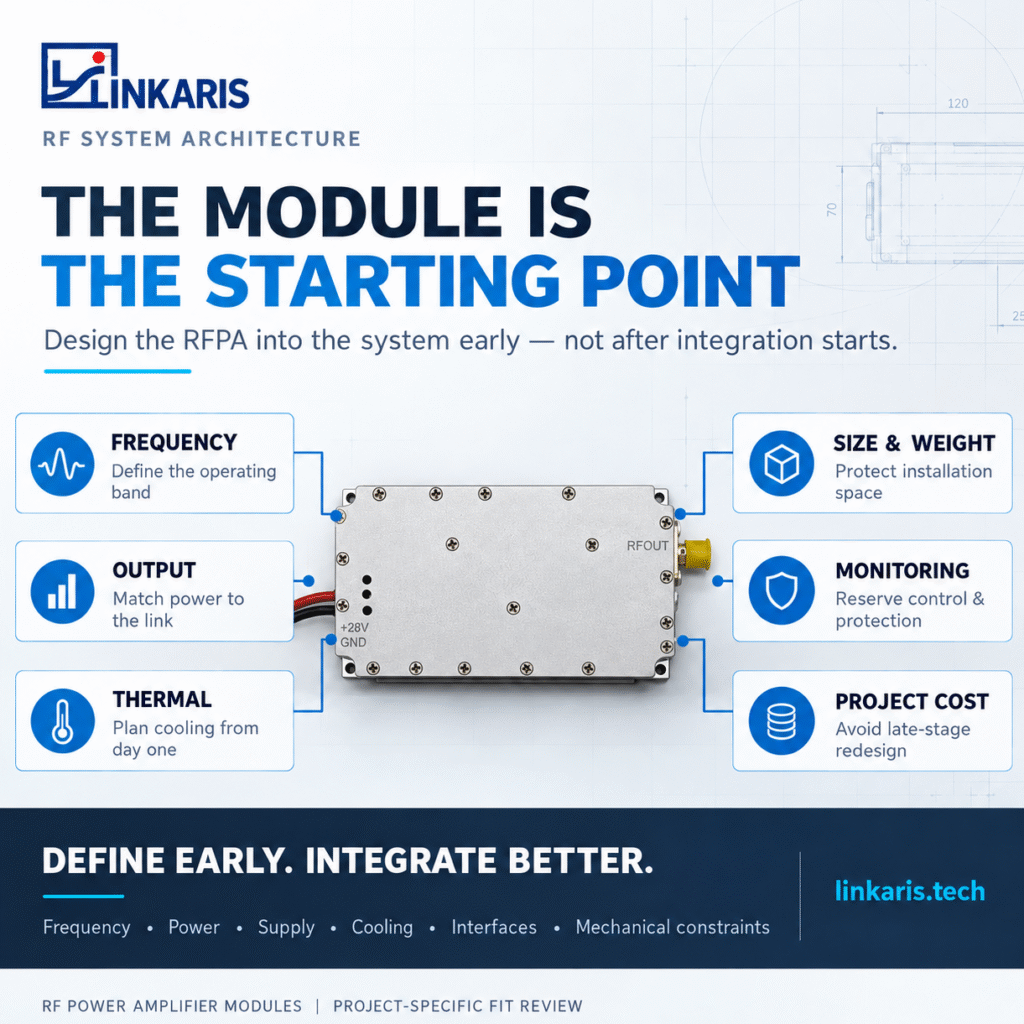
frequency, power, electrical, thermal, mechanical and interface characteristics fit the complete product architecture.
That is where RFPA selection becomes system engineering rather than component shopping.
Need a Preliminary RFPA Fit Review?
Linkaris works with customers on standard, modified-standard and project-specific RFPA module requirements across selected frequency bands.
Send us:
Frequency Band + Required Output Power + Input Drive + Supply + Operating Mode + Duty Cycle + Cooling + Mechanical / Interface Requirements
and our team can review the preliminary RFPA fit for your application.
 Chat with us on Telegram
