In many RF projects, the problem does not begin with a complete link failure.
It usually starts like this:
The link still works on the bench.
A higher-power amplifier has already been added.
Output has increased.
Short tests even show some improvement.
But once the system moves into real deployment, the same problem returns.
As interference rises, link quality starts to fluctuate.
Mid-mission, video or telemetry suddenly becomes unstable.
A result that was repeatable yesterday changes in a different environment today.
Sometimes the system looks fine for the first few minutes, then starts drifting after ten, twenty, or thirty minutes of operation.
At that point, the instinctive response is still the same:
Add more power.
That reaction is understandable.
From the surface, the problem seems to say only one thing:
the signal is not strong enough.
But if you have already tried higher output, seen some short-term improvement, and still ended up with an unstable link, then the issue is probably no longer just insufficient power.
What is more likely happening is this:
The system is starting to lose predictability.

The hardest problem is not total failure
It is a link that still works, but no longer behaves reliably.
This is one of the most difficult failure modes in high-interference RF environments.
The system is not completely down.
The amplifier is not dead.
Under some conditions, the link still holds.
But the overall system becomes:
• harder to reproduce
• harder to test consistently
• harder to diagnose
• harder for the team to trust in the next round of testing
This is where many teams make the wrong call.
Because the system still works, the problem keeps getting framed as:
Do we still need more power?
But in many cases, the issue is no longer output.
The link is drifting away from a stable, controllable, and predictable operating state.
That is why some projects keep testing, keep adjusting, and keep upgrading hardware, while communication stability never really becomes dependable
Why more output does not always create a more stable link
The default assumption is simple:
more output means a more stable link.
In some cases, that is true.
But in real systems, that logic breaks down quickly.
An RF power amplifier never works in isolation.
It is always part of an RF chain.
Once deeper problems already exist in that chain, higher output does not automatically restore stability.
In many cases, it only pushes the hidden problems into clearer view.
That is why some teams end up here:
the amplifier has already been upgraded
paper specifications look stronger
short tests look better
but real communication stability still has not been established
At that point, the issue is no longer just whether power is sufficient.
You are trying to solve a system-matching problem with more output.

Four reasons a high-power amplifier still cannot stabilize the link
1) Gain-chain mismatch
If the gain relationship between stages is not well aligned, higher output will not make the link truly stable. It will only make the system more sensitive.
In the field, this usually looks like:
• performance starts fluctuating as interference rises
• the system works in some conditions but not in others
• output increases, but link tolerance does not improve with it
This may not look obvious in short bench tests.
But in real operating conditions, as load variation, environmental change, and runtime increase, the system becomes harder to control.
2) Inconsistent behavior across the real operating range
Many link problems look like “not enough anti-interference capability,” but the deeper issue may be that modules across the chain do not behave consistently across the real operating range.
In practice, this often looks like:
• the link works in one environment and drops in another
• it looks fine at first, then changes after longer runtime
• it seems like external interference got stronger, but the behavior is not stable enough to reproduce clearly
At that point, adding more power usually means pushing further in the wrong direction.
Because the issue is not only insufficient output.
It is that the chain itself is not behaving consistently under real conditions.
3) The overall system is not truly matched to the modulation method and deployment conditions
Some problems are not caused by weak signal strength alone.
They come from the fact that the overall chain is not properly matched to the actual modulation method, data load, and deployment conditions.
You may see:
• the signal passes on the bench
• in real deployment, link quality fluctuates heavily
• output power increases, surface coverage looks better, but stability does not improve with it
That suggests the issue may not be output by itself.
It may be that actual system behavior is not well matched to real operating conditions.
4) Thermal limits under real deployment
This is one of the most underestimated causes.
A short bench test showing no issue does not mean the system will behave the same way under continuous runtime, limited cooling, constrained enclosure conditions, and changing environmental temperatures.
In many cases, the team does not see:
“the system is unstable at startup.”
They see this instead:
• the first few minutes look normal
• performance starts drifting after longer runtime
• mid-mission behavior degrades
• the same setup produces different results across repeated runs
What you see is an unstable link.
But the deeper problem may be that the system is gradually moving outside its stable operating range.
Why this is especially common in real deployment
Because real deployment is never an ideal RF environment.
Engineering teams are rarely dealing with a single variable.
More often, they are dealing with multiple pressures at once:
• stronger external interference
• longer mission duration
• faster-changing scenarios
• tighter platform space
• harsher thermal conditions
• integration constraints far more complex than bench testing
That is why many RF links do not fail suddenly.
They gradually expose system-level mismatch during the mission itself.
This is also why experienced teams eventually stop asking:
Do we just need more power?
and start asking:
Why is the system losing stability under real conditions?
That question is much closer to the root cause.
A better RFPA decision should not begin with a larger wattage number
A more useful decision process usually starts with these questions:
• What is the actual operating frequency range?
• What problem is the target output really supposed to solve?
• Under what conditions does the link begin to lose stability?
• Does the issue appear at startup, or after extended runtime?
• Is this more likely an output limitation, or a system-level mismatch?
• Which factor is more likely breaking first: thermal behavior, gain structure, chain consistency, modulation fit, or integration conditions?
Only when these questions are clearer does RFPA selection become meaningful.
Otherwise, what looks like a module upgrade may simply be a way of amplifying unresolved problems already inside the system.
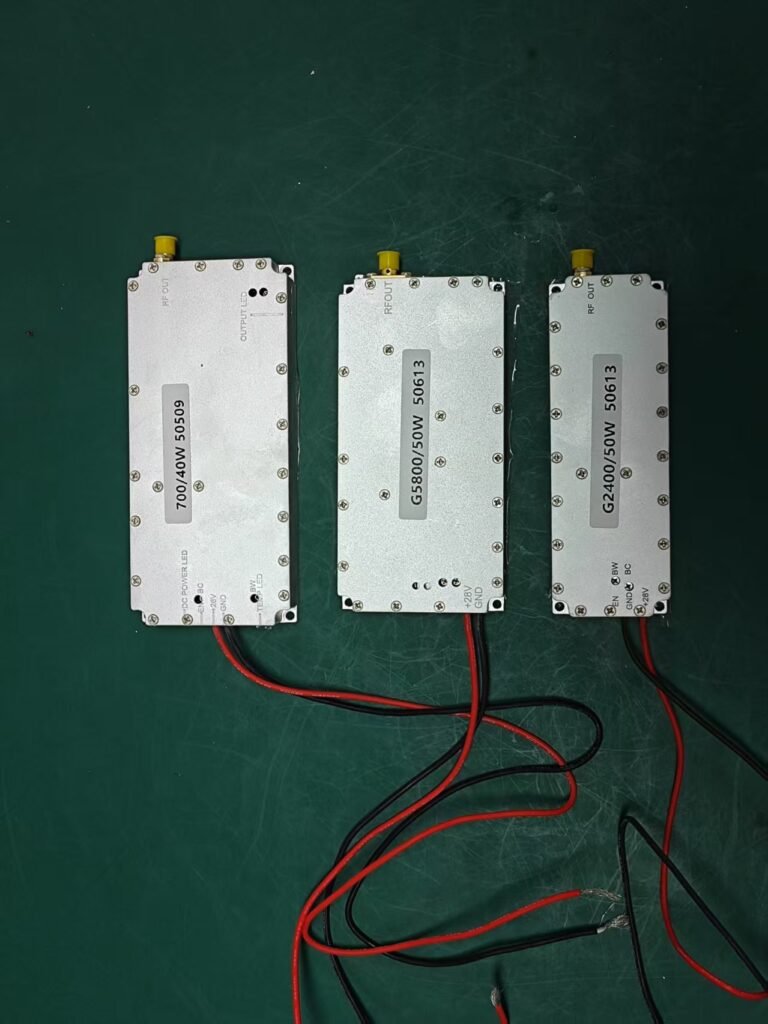
Linkaris is not only concerned with giving you a higher-power module
What matters more is this:
Once the RFPA is inside your system, will the link actually become more stable?
For many teams, the real question is not:
Can we add more power?
It is:
Is the current bottleneck caused by insufficient output, or by deeper system mismatch?
That is what Linkaris wants to help teams identify earlier.
Because if the direction is wrong, more power usually means more testing time, more rework, and more diagnostic error.
Usable is not the same as dependable.

If you are already seeing these signs
• the system already uses an RFPA, but the link is still unstable
• the link works on the bench, but not reliably in the field
• performance drops once interference rises during deployment
• link behavior drifts over time
• the team is still unsure whether the issue is output limitation or deeper mismatch
then the next step is usually not to keep adding power blindly.
It is to first clarify the actual inputs:
• frequency range
• power target
• deployment scenario
• current instability symptoms
Sending that information to Linkaris is not about starting a standard quote process.
It is about helping determine something more important first:
Do you really need more output, or do you need a more stable system match?
Getting that decision right usually saves more time than another round of blind power escalation.
Talk to Linkaris
If you are troubleshooting unstable RF links in real deployment, or if you have already added an RFPA and the system still does not behave reliably, send Linkaris the following:
• frequency range
• target power
• deployment scenario
• current failure symptoms
We can help you assess whether the issue is more likely an output limitation, or a deeper system-level mismatch.
In many cases, getting the direction right first saves more time than continuing to add power without resolving the real cause.

Final thought
In many real RF systems, the hardest problem is not low output.
It is a link that still works —
but no longer behaves in a predictable way.
 Chat with us on Telegram
