If you are choosing an RFPA by frequency and output power alone, you are probably still too early in the decision.
In many UAV communication projects, RF power amplifier selection seems simple at first.
Check the frequency band.
Check the output power.
Then compare:
10W, 30W, 50W, or 100W?
That is not wrong.
The problem is that many teams treat this as the selection process itself.
And that is exactly where later system instability often begins.
Because in real UAV, anti-drone, and high-interference environments, RFPA selection is never just about choosing a module with a bigger number.
It is about choosing an amplifier that will remain controllable, predictable, and stable after integration.
If that part is not understood early, the results usually look familiar:
- the datasheet looks fine
- bench testing looks acceptable
- initial integration appears to work
- but once the system moves into real deployment, the same problems return
Then the team starts seeing the usual symptoms: - communication quality begins to fluctuate
- control response becomes less consistent
- range improvement is smaller than expected
- long runtime starts to expose instability
- field behavior looks worse than lab behavior
At that point, it becomes clear that the real issue was never just output power.
The real issue was that the selection logic was too shallow from the beginning.
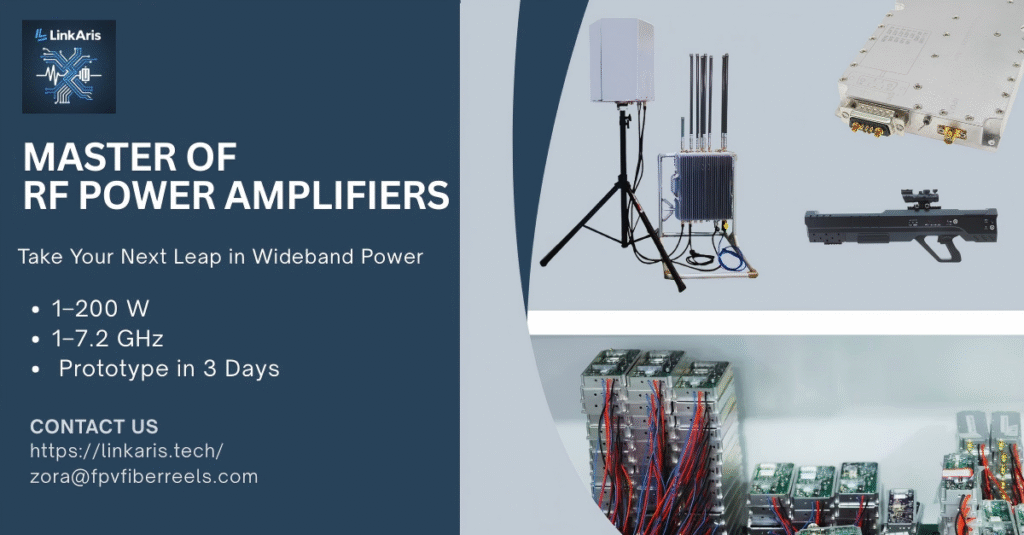
The real mistake is not choosing the wrong module first. It is using the wrong selection logic first
Many RFPA selection failures do not happen because the engineering team knows nothing.
They happen because the team relies on an oversimplified decision model.
The most common mistakes look like this:
- Only comparing output power
The assumption is simple: more power means a more reliable link. - Only checking frequency coverage
The module label says it covers the target band, so the team assumes that is enough. - Trusting datasheet behavior too early
Paper specifications are treated as system truth before real integration risks are considered. - Using bench performance as a decision shortcut
If the module performs well on the bench, the team assumes deployment will also be fine. - Ignoring integration consequences
The module is judged in isolation, without asking whether it will make the full RF chain more sensitive later.
All five mistakes come from the same deeper issue:
the team is selecting a component without thinking in terms of system behavior.
And in UAV communication systems, that is expensive.
Because what gets delivered is not a power module.
What gets delivered is a working RF link under real operating conditions.

In UAV systems, the right RFPA is the one that keeps the whole link predictable
This is the key shift.
For a UAV communication engineer or a C-UAS system integrator, an RFPA does not only amplify.
It influences:
- whether the link becomes more stable
- whether the system stays inside a healthy operating margin
- whether long-duration runtime remains predictable
- whether integration becomes easier or more painful
So the real goal is not to find the strongest RFPA.
The real goal is to find:
the RFPA that gives the system the healthiest behavior margin.
In other words, you are not selecting a more powerful module.
You are selecting whether the future system will be easier to control or harder to control.
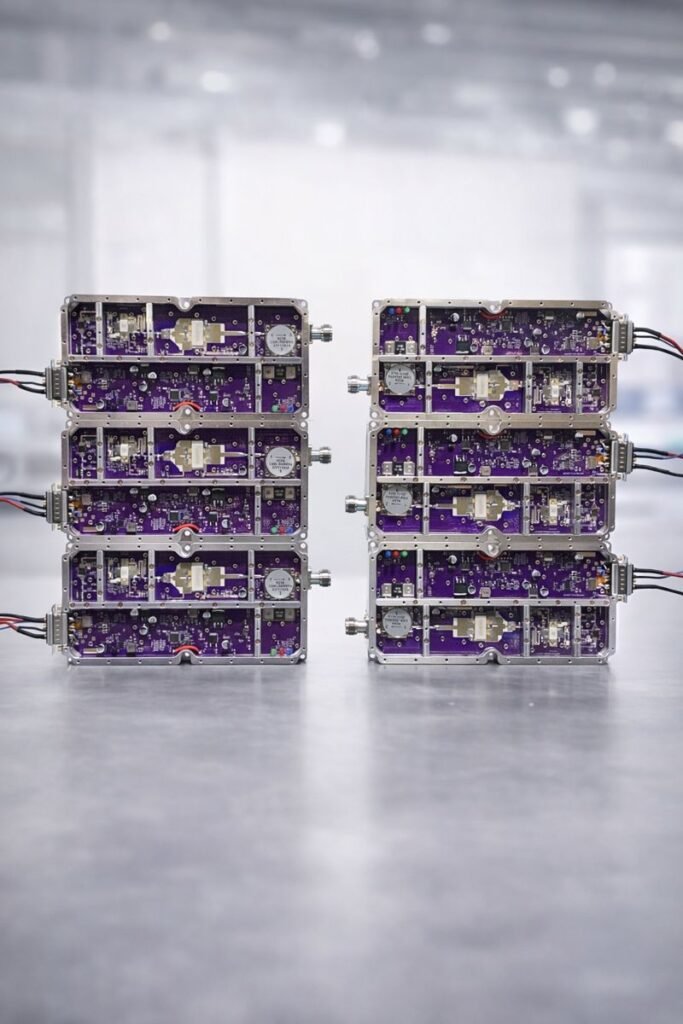
What you should actually evaluate before choosing an RFPA
The following points are what really matter when selecting an RF power amplifier for UAV communication systems.
- Frequency coverage must match the real operating band, not the marketing label
Many RFPA modules are labeled with a certain frequency range.
That does not automatically mean they will behave consistently across your real operating band.
The real questions are:
- Is your target operating point inside the effective working region?
- Is gain stable across the frequencies you actually use?
- Is output behavior consistent across the band?
- Are you relying on edge-band performance without realizing it?
- Will future requirements include multiple channels, wider bandwidth, or frequency agility?
If this is not evaluated correctly, the system usually does not fail by saying, “the frequency is wrong.”
Instead, it fails in a more frustrating way: - some operating points perform worse than expected
- some conditions produce inconsistent results
- the lab result looks acceptable, but field performance varies too much
So the real question is not:
Does it cover the band?
It is:
Does it behave consistently across the band I actually need?
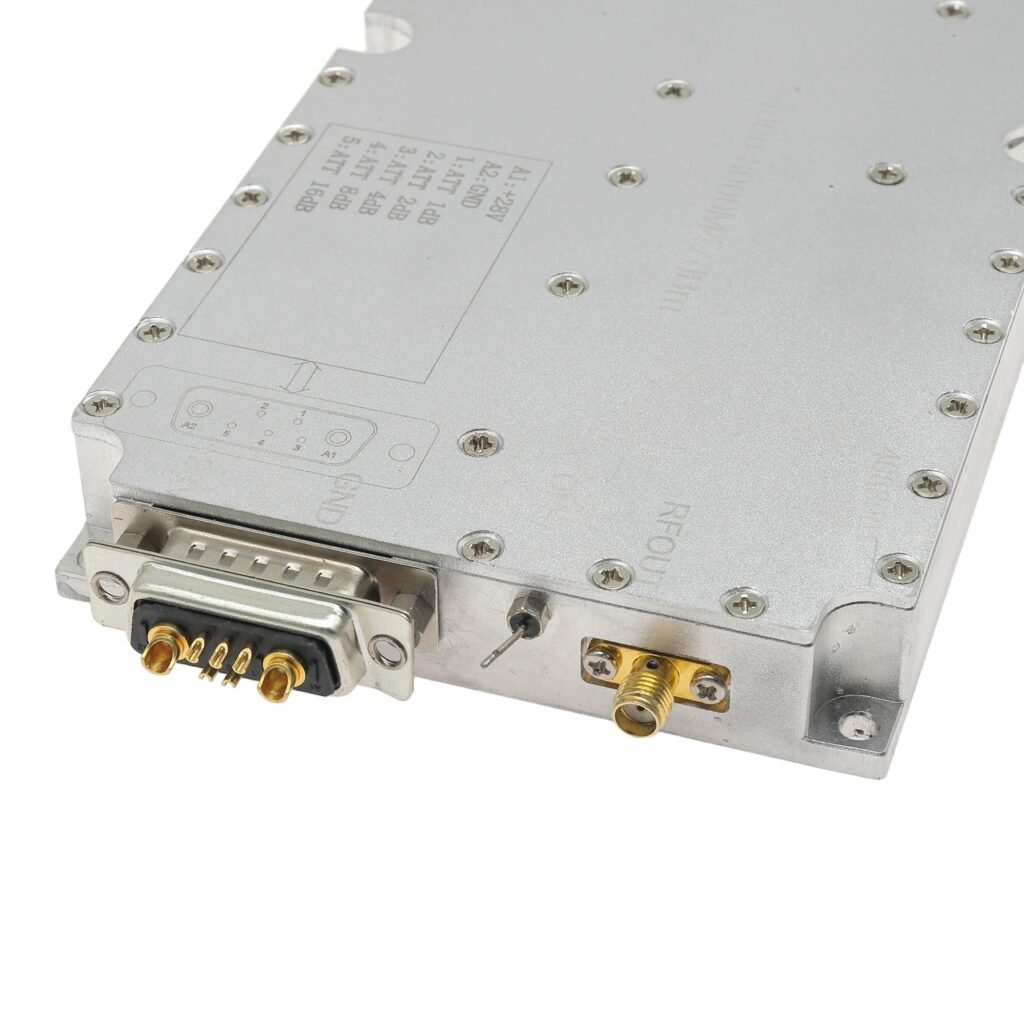
2. Output power only helps when the system can absorb it safely
This is one of the most common and most dangerous misunderstandings in RFPA selection.
Many teams assume:
higher output means better communication performance.
That idea sounds attractive.
But in real system engineering, it often fails.
Because output power only has value when the rest of the system can absorb it in a controlled way.
That means you must look at:
• whether the driver stage is appropriate
• whether gain distribution across the chain is balanced
• whether the power supply remains stable under load
• whether thermal design can support sustained operation
• whether higher output pushes the chain into a more sensitive state
If the system margin is already weak, adding more output power may not fix anything.
In some cases, it only exposes hidden weaknesses faster.
That is why some UAV projects show a confusing pattern:
• the PA output increases
• short-term testing looks better
• but long-duration behavior becomes less predictable
So the more mature question is not:
How much power can this module deliver?
It is:
What output level gives this UAV system the best balance between range, stability, and control margin?
3. Bandwidth is not a formality. It directly affects consistency
Bandwidth is often underestimated during RFPA selection.
Many teams treat it as a checkbox item.
If the module appears to support the required center frequency, they move on.
But real systems do not operate at one perfect point under one perfect condition.
If bandwidth behavior is not healthy, the consequences are often subtle at first but serious later:
• performance varies across frequencies
• system response becomes less consistent under changing conditions
• integrated behavior becomes harder to predict
• deployment results differ from what the lab suggested
For UAV communication and anti-drone systems, this matters even more.
Because these are not short, controlled demonstrations.
They are real systems expected to work in dynamic and stressful environments.
So bandwidth is not just a line in a table.
It affects whether your RFPA supports system consistency or introduces more variability.
4. Thermal behavior is one of the fastest ways to expose a bad selection
This is one of the most common reasons a project looks fine on the bench but struggles in the field.
On the bench, equipment is often newly powered, runtime is short, and the environment is controlled.
In real deployment, thermal behavior starts separating good selections from bad ones.
That is where teams begin to see:
• gain drift over time
• output consistency degrading
• growing sensitivity to mismatch
• decreasing predictability during long runtime
At that point, the team may blame the environment, the integration, or the link budget.
But the real issue may have started much earlier — during RFPA selection.
That is why thermal behavior cannot be treated as a secondary mechanical issue.
It must be evaluated as part of RF behavior itself.
The real questions are:
• How does the module behave after extended runtime?
• Does gain remain stable as temperature rises?
• Does output stay consistent under thermal stress?
• Does heat push the chain into a more sensitive operating state?
For UAV systems, you are not choosing a PA that looks good at startup.
You are choosing a PA that can still behave well after the system is under stress.
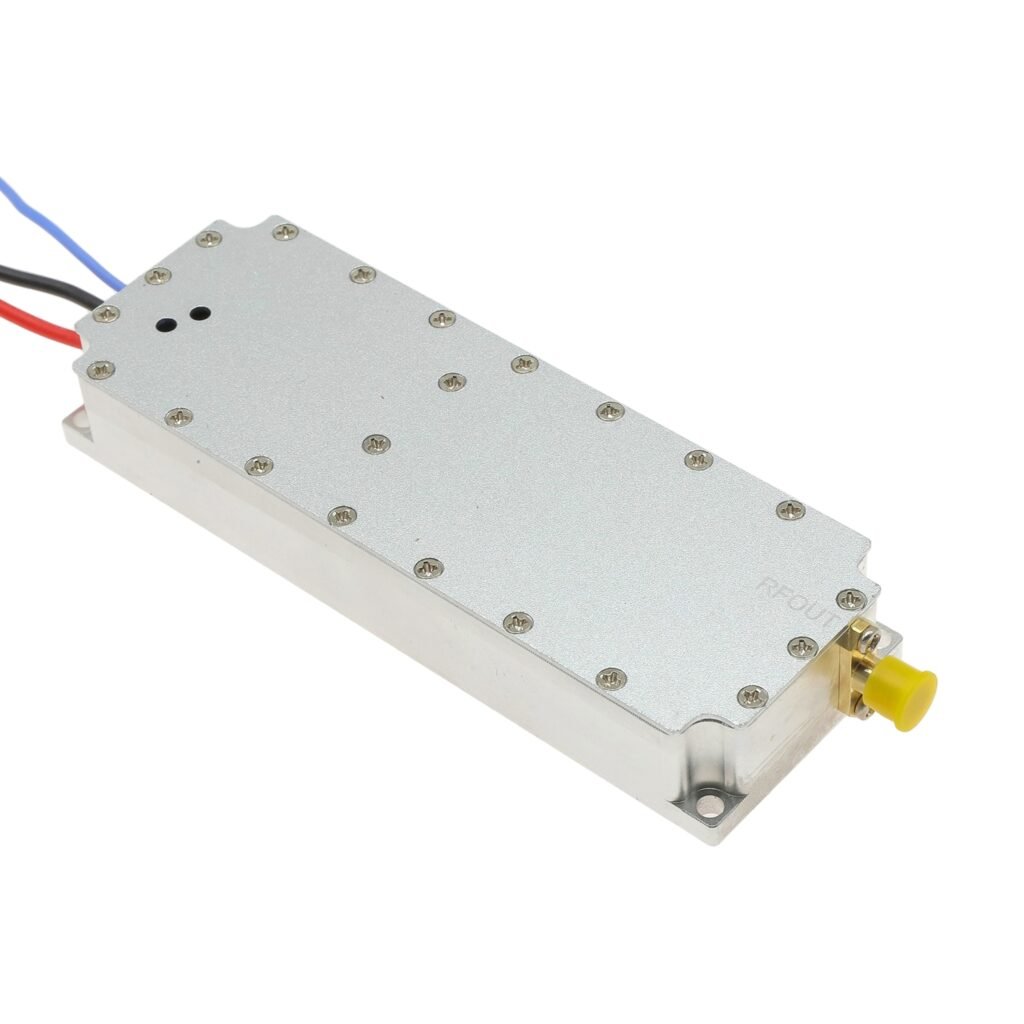
5. Gain structure and mismatch tolerance often determine whether integration stays manageable
Many RFPAs appear acceptable when viewed as standalone modules.
But once integrated into a full system, they can make the RF chain much harder to manage.
Two common reasons are:
Unhealthy gain structure
If the gain distribution between the driver, PA, and later stages is not well balanced, the chain may become:
• easier to overdrive
• more sensitive to operating changes
• less consistent under real deployment conditions
• harder to optimize across different scenarios
Weak mismatch tolerance
In real systems, perfect matching is not permanent.
Once mismatch begins to appear, the consequences can spread quickly:
• reflection increases
• chain stress rises
• stability margin shrinks
• field behavior becomes harder to predict
That is why the right question is not:
Can this RFPA work?
The better question is:
Will this RFPA make the entire RF chain easier or harder to control after integration?
That is what system integrators should care about most.
6. Field reliability matters more than impressive numbers on paper
In engineering projects, the most expensive outcome is not buying the wrong module once.
The real cost is what happens after that:
• one wrong selection
• one integration rework cycle
• one delayed test schedule
• one unstable deployment result
So for teams building real UAV communication systems, the most valuable RFPA is rarely the one with the most exciting paper numbers.
It is the one that helps the system land more reliably in the real world.
That means prioritizing:
• predictability
• integration compatibility
• long-runtime stability
• consistent behavior in contested environments
If a module cannot provide those, even a strong datasheet becomes much less valuable.
The best RFPA is not the one that looks strongest. It is the one that reduces future system risk
This is the most important line in the article.
Many teams approach RFPA selection like a module comparison exercise.
More mature teams approach it as a risk-control decision.
Because the module you choose now affects whether, in the coming months:
• integration becomes smooth or painful
• runtime stays stable or becomes unpredictable
• field behavior remains controllable or starts drifting
• the team moves forward or keeps reworking the same problem
So if your selection logic still focuses mainly on:
• frequency
• output power
• price
• short-term bench results
then you are still not at the core of RFPA selection.
The real question is:
Which RFPA reduces risk across the entire UAV communication system?
Final takeaway
Choosing an RFPA for UAV communication systems is not about finding the most powerful option.
It is about finding the option that gives your system the best chance to remain stable, predictable, and controllable after integration.
If an RFPA only gives you higher output but makes the system harder to manage later, it is not truly the better choice.
If an RFPA improves the health of the system across frequency coverage, output level, bandwidth behavior, thermal stability, gain structure, and deployment consistency, then it has real selection value.
That is the standard that matters.
Choosing an RFPA for a UAV communication system? Don’t decide from the datasheet alone.
Send your parameters.
We can help evaluate:
• operating frequency
• required output level
• bandwidth fit
• thermal risk
• gain structure
• integration compatibility
Or request checklist.
If you are selecting an RF power amplifier for a 200 MHz–8 GHz system, ask for the RFPA selection checklist before committing to a module.
 Chat with us on Telegram
