| Does the target depend on a radio-frequency link for control? |
RF suppression can be effective when a UAV relies on wireless links for command and control, telemetry, video transmission or navigation.
But when the primary control path does not depend on RF—such as with a fiber-controlled FPV drone—traditional RF jamming may not interrupt the connection that keeps the aircraft under operator control.
This distinction defines both the value and the engineering boundary of an RF power amplifier within a counter-UAS system.
Scenario A: The Threat Depends on RF
Many conventional UAVs rely on one or more radio links:
- Command and control;
- Telemetry;
- Video downlink;
- GNSS reception;
- Additional positioning or data channels.
When one of these RF links is essential to flight or mission operation, a counter-UAS system may attempt to detect, classify and selectively suppress it.
A simplified RF suppression transmitter chain may include:
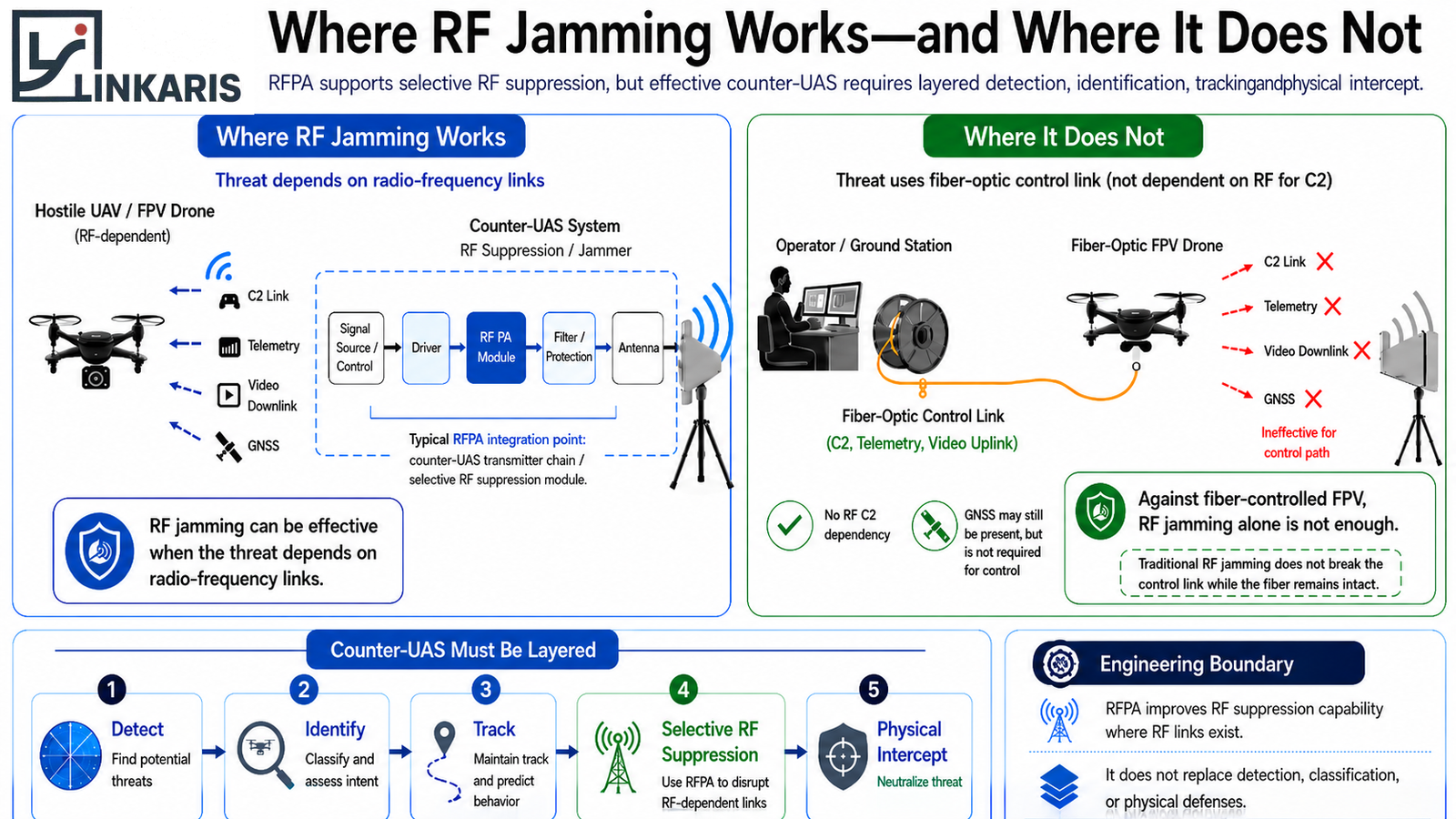
| Signal source and control → Driver → RFPA module → Filter and protection → Antenna |
Within this chain, the RFPA module provides the required power gain before the signal reaches the filtering and antenna stages.
Its role is important—but specific.
The amplifier does not decide which signal is hostile, which frequency should be addressed or when transmission should begin. Those decisions depend on the wider sensing, classification and control architecture.
The RFPA contributes after the system has already determined:
- Which RF link is relevant;
- Which band must be covered;
- What output level is required;
- How the signal should be transmitted;
- What operating conditions the hardware must withstand.
When these conditions are correctly defined, RF suppression may affect a target’s control, telemetry, video or navigation-dependent functions.
Scenario B: The Primary Control Path Is Fiber
A fiber-controlled FPV drone changes the problem.
Instead of carrying command data over a wireless control link, the aircraft remains connected to the operator through a physical fiber-optic cable.
Depending on the platform, the fiber may carry:
- Command-and-control data;
- Telemetry;
- Video transmission;
- Other mission information.
In this case, the primary control path is not travelling through the RF spectrum.
Traditional RF jamming therefore cannot break that connection while the fiber remains intact.
The aircraft may still contain GNSS receivers or secondary radio functions. Those signals may remain detectable or technically addressable, but that does not necessarily mean the operator will lose control.
| The presence of RF signals does not prove that the platform depends on RF for control. |
Counter-UAS effectiveness must therefore be evaluated against the target’s actual link architecture—not only against the presence of antennas, GNSS or detectable emissions.
The Decision Gate: Is RF Suppression Relevant?
Before specifying an RFPA, the counter-UAS system designer should answer four questions.
1. Which link is operationally essential?
Is the aircraft dependent on:
- A radio control channel;
- A video link;
- GNSS;
- A fiber connection;
- A pre-programmed route;
- An autonomous navigation system?
The system must identify which link actually determines continued operation.
2. Is that link transmitted over RF?
If the essential control path is radio-based, selective RF suppression may be relevant.
If it is fiber-based or fully autonomous, RF suppression alone may not remove control.
3. Can the signal be detected and classified?
RF power should not be applied as a substitute for signal awareness.
The system should first determine:
- Whether the signal is present;
- Whether it belongs to the target;
- Which band or channel is involved;
- Whether the selected response is appropriate.
4. What happens if RF suppression does not stop the threat?
A complete counter-UAS architecture must account for targets that:
- Continue operating after GNSS disruption;
- Change frequency or waveform;
- Use non-RF control;
- Follow autonomous or pre-programmed routes.
This is why RF suppression must operate as one layer within a broader response framework.
Counter-UAS Must Be Layered
A practical counter-UAS architecture may include five coordinated stages.
1. Detect
The system first identifies the presence of a potential aerial threat. Detection may involve radar, RF sensing, optical systems or multiple sensors working together.
2. Identify
The object must then be classified. This includes determining whether it is a legitimate aircraft, an RF-controlled UAV, a fiber-controlled FPV platform, a GNSS-dependent system, or a partly or fully autonomous threat.
3. Track
Continuous tracking supports situational awareness and response coordination. It may also support directional transmission, sector control and response timing.
4. Apply Selective RF Suppression
When the threat depends on an identifiable RF link, the system may apply controlled RF energy against the relevant band. This is the layer where the RFPA module contributes directly. The objective is not simply to generate the highest possible wattage. The objective is to deliver the required RF output within the correct frequency, duty-cycle, thermal and antenna conditions.
5. Use an Additional Response Layer
When the threat does not depend on RF—or when RF suppression does not achieve the required result—the system must rely on other authorized response methods. The specific solution depends on local regulations, safety constraints and operational requirements.
| RF suppression does not replace detection, identification, tracking or non-RF response capabilities. |
The Engineering Boundary of an RFPA Module
An RFPA can strengthen the selective RF suppression layer, but it is not a complete counter-UAS solution.
| An RFPA module can support | An RFPA module does not replace |
| Defined-band RF power amplification | Threat detection |
| Required output-power delivery | Target identification |
| Input-drive and gain matching | Signal classification |
| CW, pulsed or intermittent operation | Target tracking |
| Thermal and mechanical integration | Engagement logic |
| Filter and antenna-chain compatibility | Non-RF countermeasures |
| Load protection and monitoring | Physical interception |
This distinction matters during both procurement and system design.
A request such as “We need a high-power jammer amplifier” is not yet a complete RFPA requirement.
The project must first establish which RF-dependent link is being addressed and how the amplifier will operate inside the wider transmitter chain.
What the RFPA Specification Should Follow
Once the system has confirmed that RF suppression is relevant, the amplifier requirement can be defined around the real operating conditions.
Typical inputs include:
- Selected frequency band or sub-band;
- Required output power;
- Available input-drive level;
- Supply voltage and current;
- CW, pulsed or intermittent duty cycle;
- Cooling method;
- Mechanical space and mounting;
- Connector and interface requirements;
- Filter and antenna conditions;
- Expected load mismatch and protection needs.
These parameters should follow the system-level decision—not replace it.
A technically suitable amplifier in the wrong counter-UAS architecture will not solve the underlying problem.
From “How Much Power?” to “Which Link Matters?”
The most useful counter-UAS question is not:
| How much RF power can the system generate? |
It is:
| Which link does the threat depend on, and can that link be affected through RF? |
When the answer is yes, the RFPA becomes a critical part of the selective suppression transmitter.
When the answer is no, increasing amplifier power does not change the control architecture of the target.
That is the engineering boundary.
Linkaris RFPA Integration Support
Linkaris develops application-specific RF power amplifier modules for integration into RF transmitter systems.
For selective RF suppression projects, our role is to help system integrators evaluate the RF power stage based on the defined operating requirement, including frequency, output power, input drive, duty cycle, supply, thermal conditions and system interface.
Linkaris does not provide a complete counter-UAS platform.
We support the part of the architecture where controlled RF output must be generated reliably within a defined transmitter chain.
Conclusion
RF jamming can be effective when the threat depends on a radio-frequency link.
It becomes less effective—or irrelevant to the primary control path—when the target uses fiber, autonomy or another non-RF method.
The correct RFPA specification therefore begins with one question:
| What does the target actually depend on? |
Only after that question is answered should engineers define frequency, power and amplifier integration requirements.
| Evaluating the RF suppression layer of a counter-UAS architecture?Linkaris can review how an RF power amplifier module may fit within the defined transmitter chain, frequency range and operating conditions. |
 Chat with us on Telegram
