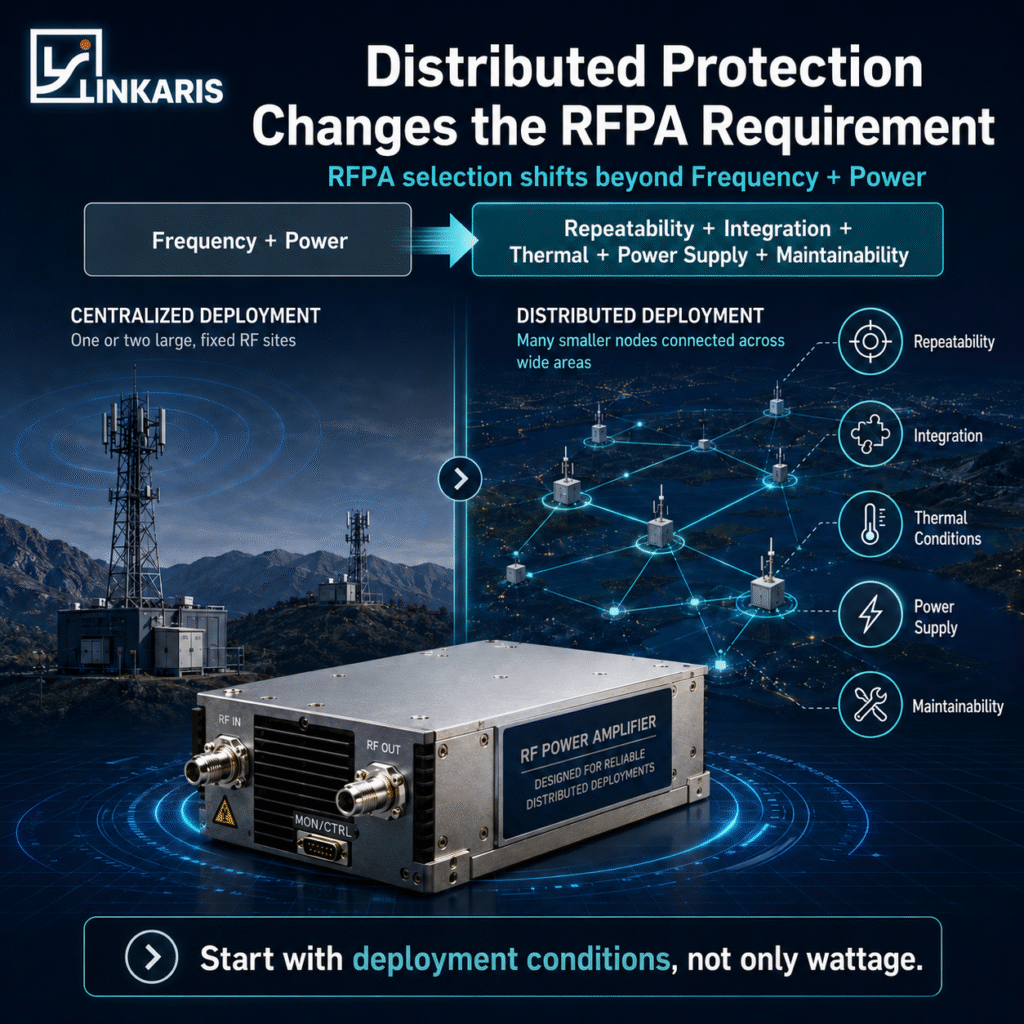
Why Multi-Node Deployment Turns RFPA Selection Into a Repeatability and Integration Problem
A single RFPA node is an engineering problem.
Fifty RFPA nodes become an architecture problem.
As RF systems move from a small number of centralized installations toward multiple distributed nodes, amplifier selection has to change with the deployment model.
In a centralized architecture, engineers may work around one power environment, one cooling strategy, one enclosure and one defined installation condition.
Distributed deployment introduces something different:
variation at scale.
The RFPA is no longer evaluated only as an individual module.
Engineers also have to determine whether the same RFPA configuration can be repeated, integrated, replaced and maintained across multiple nodes without creating new engineering work at every installation.
That changes the requirement.
1. Centralized and Distributed RFPA Deployment Are Different Engineering Problems
The RF requirements at the module level may initially look similar.
The system may still need a defined frequency band, target output power and input drive level.
But the deployment conditions surrounding that module can be very different.
| Decision Dimension | Centralized Deployment | Distributed Deployment |
|---|---|---|
| Number of installations | Limited | Multiple repeated nodes |
| Operating environment | Relatively controlled | Conditions may vary by node |
| Cooling strategy | Usually defined for one site | Must work within a defined deployment envelope |
| Power architecture | Site-specific | Compatibility may need to be repeated across nodes |
| Mechanical integration | One primary installation | Multiple installations may introduce variation |
| Replacement | Local engineering adjustment may be manageable | Interchangeability becomes more important |
| Verification | Individual module performance | Module performance + configuration repeatability |
| Maintenance | Site-level issue | Scales with node count |
The difference is therefore not simply that a distributed system uses more amplifiers.
It is that every integration decision is multiplied by the number of nodes.
2. Distributed Deployment Multiplies Variation
Consider one RFPA installed in a controlled environment.
The module has:
- a defined power supply
- a known cooling structure
- a fixed enclosure
- established RF interfaces
- a known mounting arrangement
Once the same architecture is deployed across many locations, those assumptions may no longer remain identical.
One node may have better airflow.
Another may operate inside a tighter enclosure.
One installation may have more available electrical margin.
Another may have a different cable route or mounting structure.
Individually, these differences may appear small.
Across a distributed platform, however, they create a new engineering question:
How much variation can the RFPA configuration tolerate before the deployment requires node-specific adjustment?
That is where RFPA selection starts becoming a deployment-level decision rather than only a module-level decision.
3. Define the Deployment Envelope Before Repeating the RFPA
For distributed systems, one of the most useful concepts is the deployment envelope.
The deployment envelope defines the range of operating and integration conditions within which the same RFPA configuration is expected to remain suitable.
It may include conditions such as:
Electrical environment
Available supply voltage, current capability and operating mode.
Thermal environment
Cooling method, airflow, conduction path and expected ambient conditions.
Mechanical environment
Available dimensions, mounting surface, enclosure restrictions and connector access.
RF-chain environment
Input drive, required output level, interface conditions and surrounding RF components.
Operational environment
CW, pulsed or intermittent operation, expected duty cycle and maintenance requirements.
The objective is not to make every node physically identical.
The objective is to determine whether the variation between nodes remains inside a range that one validated RFPA configuration can support.
That distinction matters.
Without a defined deployment envelope, engineers may discover integration differences only after multiple nodes have already been designed.
4. One Successful RFPA Sample Does Not Prove Deployment Repeatability
A prototype passing a laboratory test is important.
But it answers only one question:
Did this module work under these test conditions?
Distributed deployment introduces another:
Can the required behavior be repeated across multiple modules and multiple installations?
As node count increases, unit-to-unit and installation-to-installation consistency becomes increasingly valuable.
For example, if every replacement module requires additional adjustment, the burden may be acceptable for one site.
Across dozens of nodes, the same adjustment becomes recurring engineering work.
This is why distributed deployment increases the importance of:
configuration consistency, repeatable verification and defined acceptance criteria.
The target is not necessarily that every measured value is perfectly identical.
The target is that production units remain within an agreed operating and acceptance window that allows the RFPA configuration to be repeated without redesigning the surrounding RF chain.
5. Interchangeability Changes the Design Question
Distributed platforms also make replacement strategy more important.
In a centralized system, engineers may have direct access to the installation and can sometimes accommodate local modifications.
That becomes less attractive when many RF nodes are deployed across different locations.
A more useful question is:
If one RFPA is removed, can another qualified unit replace it without changing the RF chain around the module?
This is where interchangeability becomes part of RFPA evaluation.
Interchangeability may depend on more than physical dimensions.
Engineers may also need consistency in:
- RF interfaces
- power interfaces
- control interfaces
- mounting conditions
- cooling interfaces
- operating behavior
- verification criteria
If every replacement requires a new integration exercise, the system may technically remain functional while becoming increasingly difficult to support.
For multi-node deployment, the RFPA should therefore be evaluated not only for initial performance, but also for its role as a repeatable system building block.
6. Maintenance Burden Scales With Node Count
Distributed deployment changes the economics of small engineering decisions.
Suppose one RFPA installation requires ten additional minutes of adjustment.
For one module, that may be irrelevant.
For fifty modules, the same task becomes more than eight hours of repeated work.
The same scaling effect applies to:
- troubleshooting
- cable changes
- cooling adjustments
- connector access
- module replacement
- acceptance testing
- field servicing
This is why maintainability cannot be treated only as an after-sales issue.
It starts during architecture selection.
A configuration that is slightly easier to replace, verify or integrate may become significantly more valuable once the deployment is multiplied across many nodes.
7. Small Integration Problems Become Architecture Problems
Distributed systems amplify both good and bad RFPA decisions.
Consider three examples.
Case A — Cooling
A module operates correctly in the original enclosure, but another node provides less airflow.
The issue is no longer simply thermal performance.
The question becomes whether the entire node family requires different cooling solutions.
Case B — Power Supply
A module performs correctly with one electrical architecture, but another node has less available current margin.
The issue becomes whether the RFPA configuration can remain common across the deployment.
Case C — Replacement
A replacement unit fits mechanically but requires different RF-chain adjustment.
The problem is no longer one module.
It becomes a fleet-level maintenance issue.
The common pattern is simple:
Node count turns local integration differences into system-level complexity.
8. RFPA Acceptance Also Changes With Distributed Deployment
Traditional RFPA verification may focus primarily on whether an individual unit meets defined RF and electrical specifications.
Distributed deployment adds another layer.
The buyer may also need to define what must remain repeatable from node to node.
This can lead to two levels of acceptance.
Module Acceptance
Does the individual RFPA meet the required electrical and RF criteria?
Deployment Acceptance
Can qualified modules operate inside the defined deployment envelope without creating unacceptable differences in integration, verification or maintenance?
That distinction becomes increasingly important when the RFPA is expected to be reproduced across multiple installations.
It also helps move project discussions away from an undefined expectation of “all units should be the same” toward a more practical engineering question:
Which parameters and interfaces must remain controlled for the deployment to remain repeatable?
9. The Requirement Should Follow the Deployment Architecture
For a single prototype, engineers may initially focus on:
Frequency + Output Power + Input Drive
For distributed deployment, the decision framework becomes broader:
**RF Performance
- Deployment Envelope
- Repeatability
- Interface Consistency
- Interchangeability
- Verification
- Maintainability**
The important point is not that every distributed RF system requires a completely customized amplifier.
In many cases, the better engineering approach may still be to preserve a validated RFPA core and control the variables around it.
Depending on the project, that could mean using:
- a standard module
- a modified-standard configuration
- a project-specific RFPA configuration
The correct path depends on how much the deployment conditions differ from the validated operating environment.
10. From RFPA Module to Repeatable Deployment Building Block
This is the larger shift created by distributed RF architecture.
The buyer is no longer asking only:
Can this RFPA achieve the required performance?
The stronger question is:
Can this RFPA configuration become a repeatable building block across the deployment?
That requires engineers to consider the module together with:
node architecture, installation variation, acceptance criteria and maintenance strategy.
A successful RFPA therefore needs to do more than pass one controlled test.
It needs to fit into an engineering framework that can be reproduced.
Linkaris Perspective: Start With the Deployment Conditions
For Linkaris, RFPA evaluation starts with the conditions surrounding the module—not only the wattage on the datasheet.
For a distributed or multi-node RF platform, a preliminary requirement review can begin with:
- frequency band
- target output power
- available input drive
- supply voltage and current conditions
- operating mode and duty cycle
- cooling method
- mechanical installation conditions
- RF and control interfaces
- expected differences between nodes
- estimated deployment quantity
- replacement and maintenance requirements
The purpose is to determine whether the same RFPA configuration can reasonably be repeated across the deployment and which conditions should be controlled before the architecture scales.
Conclusion
Distributed deployment does not simply increase the number of RF power amplifiers in a system.
It changes what makes an RFPA configuration valuable.
When one installation becomes many nodes, engineering priorities begin to move from isolated module performance toward:
deployment envelope, repeatability, interchangeability and maintainability.
That is why the RFPA question changes from:
“Does this amplifier work?”
to:
“Can this amplifier configuration be repeated across the system without multiplying integration problems?”
For multi-node RF platforms, that distinction can determine how easily the system moves from prototype to deployment.
Evaluating RFPA Modules for a Distributed RF Platform?
Share your frequency band, target output, input drive, supply conditions, operating mode, cooling method and deployment constraints.
Linkaris can use these conditions as the starting point for a preliminary RFPA fit review.
 Chat with us on Telegram
