A practical decision framework for system integrators
| Core decision ruleAn RFPA project should not become custom merely because the inquiry is new. The right path is the least-complex validated architecture that can reliably meet the real operating conditions. |
A required frequency band and output power do not automatically justify a new amplifier design. In many projects, the RF power stage may already be suitable, while only the gain chain, supply interface, mechanical arrangement or control functions need adjustment.
For a system integrator, the key question is therefore not simply “standard or custom?” It is: which part of the existing RFPA platform no longer fits the system, and how deeply does that difference affect the validated architecture?
That distinction matters because over-customization can add unnecessary engineering cost, validation work and supply risk. Under-customization can be equally expensive if a seemingly suitable standard module later fails to match the input drive, duty cycle, cooling path or load environment.
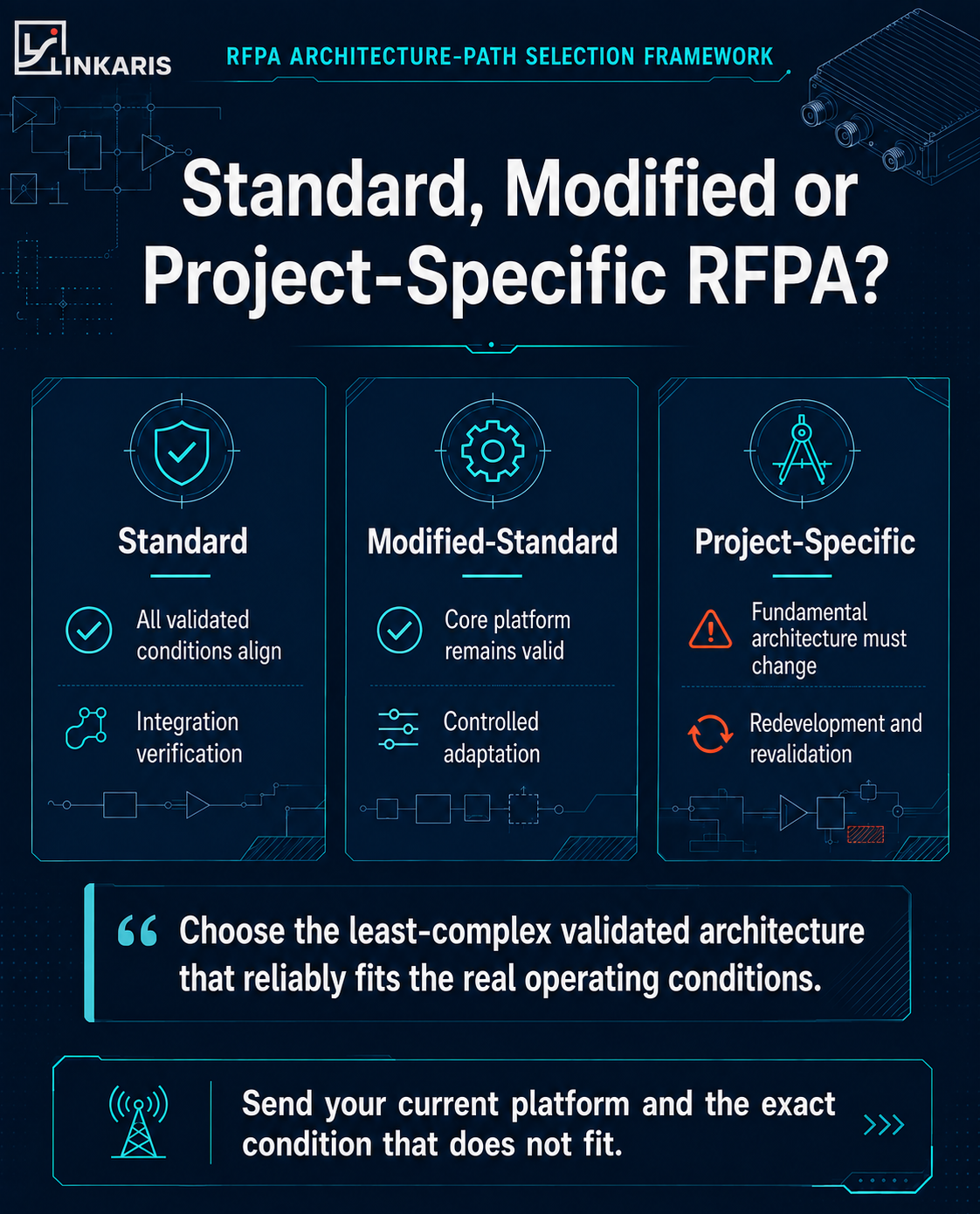
At a Glance: Three Development Paths
| Development path | When it fits | Primary value |
| Standard RFPA module | The validated electrical, thermal, mechanical and control conditions already align with the platform. | Fastest route with the lowest design uncertainty. |
| Modified-standard RFPA | The core platform remains suitable, but selected gain, supply, interface, monitoring, mechanical or thermal details must change. | Balances proven architecture with controlled adaptation. |
| Project-specific RFPA architecture | The RF power stage, combining method, bandwidth, DC/thermal architecture or protection concept must change substantially. | Used when the operating conditions cannot be supported responsibly by the existing platform. |
The classification is preliminary until the requirement is reviewed against the validated limits of an actual RFPA platform.
The Decision Is About Architectural Impact
The word “custom” is too broad to guide an engineering decision. A more useful method is to identify which architecture layer is affected.
| Architecture layer | Typical requirements | What the change usually means |
| 1. RF power stage | Frequency band, bandwidth, transistor stage, matching, filtering and power combining | Changes here are most likely to trigger a project-specific architecture. |
| 2. Drive and control | Input level, gain budget, driver stage, gain control, enable logic and telemetry | May remain modified-standard if the output stage and thermal envelope remain valid. |
| 3. DC and thermal | Supply voltage/current, transient margin, duty cycle, baseplate temperature and cooling method | A large departure can invalidate an otherwise suitable RF platform. |
| 4. Mechanical and system interface | Dimensions, mounting, connector position, harness, control interface and enclosure integration | Often suitable for a controlled platform modification. |
| Practical boundaryIf the RF output stage and its validated DC/thermal envelope remain suitable, the project may often be handled as a modified-standard configuration. If the output stage, combining architecture or thermal concept must be redefined, the project is more likely to require a project-specific RFPA architecture. |
1. Standard RFPA Module
A standard RFPA is appropriate when the system can accommodate an existing validated configuration without material changes to its RF, DC, thermal, mechanical or control conditions.
A standard path is usually credible when:
- The exact operating band and required output power are already supported.
- The available input drive matches the existing gain architecture.
- The platform can provide the specified voltage, current and transient margin.
- CW, pulsed or intermittent operation remains within validated duty-cycle conditions.
- The cooling interface and expected baseplate or ambient temperature are compatible.
- The load environment, VSWR conditions and protection requirements are within the existing design scope.
- Mechanical dimensions, connectors and control functions are acceptable.
The main benefit is not simply speed. It is reduced uncertainty: the electrical and thermal behavior has a known baseline, and the required validation effort can remain focused on the customer integration rather than on a new amplifier architecture.
2. Modified-Standard RFPA
A modified-standard RFPA uses an established platform but changes selected elements to fit the customer system. This is often the most commercially and technically efficient path for project-based integration.
Typical controlled modifications include:
- Frequency sub-band optimization within an established platform range
- Input-drive or gain adjustment while retaining the main output stage
- Supply-interface adaptation within the validated DC envelope
- Connector position, mounting-hole pattern or mechanical outline changes
- Heat-spreader, housing or airflow-interface adjustment
- Enable, mute, monitoring or communication-interface changes
- Forward/reflected-power, temperature or current telemetry
- Second-source adaptation with defined drop-in constraints
A modification is not automatically minor simply because it appears small on a drawing. Lower input drive may require an additional driver stage. A longer duty cycle may change average dissipation. A different enclosure may restrict the heat path. Each requested change must therefore be checked for its impact on gain, DC consumption, thermal headroom, stability and protection.
3. Project-Specific RFPA Architecture
A project-specific architecture is justified when the requirement cannot be supported responsibly by the validated platform envelope. This does not imply that every component is designed from zero. It means that one or more fundamental RF, power, thermal or control functions require substantial redevelopment and revalidation.
Typical triggers include:
- A new frequency architecture or substantially wider bandwidth
- A different output-power stage or power-combining method
- A gain requirement that materially changes the driver chain
- A shift from intermittent operation to sustained CW without sufficient thermal headroom
- A supply architecture incompatible with the existing bias and power stages
- Unusual mismatch, switching or reflected-power conditions requiring a new protection strategy
- Size, weight or cooling constraints that require a new mechanical and thermal concept
- Project-specific control or telemetry that changes the internal system architecture
Project-specific development should be selected because the system requires a different architecture, not because the requirement is absent from a catalogue.
A Practical RFPA Classification Matrix
| Project condition | Likely path | Engineering reason | Validation focus |
| Existing band, power, input, supply and cooling all align | Standard | No material architecture change | Integration verification |
| Connector, mounting or control interface differs | Modified-standard | RF power stage can remain unchanged | Mechanical/control validation |
| Sub-band tuning within an established platform | Modified-standard | Core architecture may remain valid | RF tuning and full-band test |
| Lower input drive requires an added driver stage | Engineering boundary review | May remain modified-standard only if DC/thermal/stability limits remain valid | Gain chain, current and thermal revalidation |
| Intermittent design must operate CW at the same output power | Project-specific or major requalification | Average dissipation and cooling requirement change materially | Sustained thermal and stability validation |
| Significantly wider bandwidth is required | Project-specific | Matching, gain flatness, efficiency and stability must be rebalanced | New RF architecture validation |
| Different power-combining method is required | Project-specific | Output stage and thermal distribution change | RF, DC, thermal and protection validation |
| Second-source module must fit an existing system envelope | Usually modified-standard | Interfaces and operating conditions are constrained by the incumbent design | Drop-in compatibility and system test |
| Unusual VSWR or antenna-switching conditions apply | Engineering boundary review | Protection and recovery behavior may need redesign | Mismatch, recovery and durability testing |
“Engineering boundary review” means the classification cannot be decided from the request label alone. The answer depends on whether the change remains inside the validated RF, DC and thermal headroom of the existing platform.
Five Questions That Decide the Development Path
1. Does the RF power stage still fit?
Confirm the exact band, required bandwidth, minimum output across the band, gain flatness, linearity or spectral requirements, and whether a different combining method is needed.
2. Does the gain chain still fit?
Compare available input drive with the required output power. A change from +20 dBm input to 0 dBm input can require a different driver stage even when the band and output power are unchanged.
3. Does the DC and thermal envelope still fit?
Confirm available voltage, continuous and peak current, operating mode, on-time, duty cycle, cooling method, ambient conditions and permitted temperature rise.
4. Does the load and protection concept still fit?
Review antenna or filter losses, expected VSWR, reflected power, switching events, protection thresholds and recovery behavior.
5. Are the changes limited to system integration?
Identify required dimensions, weight, mounting, connector positions, harnesses, enable logic, telemetry and communication interfaces.
Illustrative Case: When a “Custom” Request Is Actually Modified-Standard
| Illustrative example – not a public product or capability claimA system integrator identifies an existing RFPA platform with the required frequency band and output-power class. The system, however, provides 0 dBm input instead of the platform’s higher drive level, requires relocated RF/DC connectors and needs RS485 telemetry. |
The initial classification would examine the architecture layer affected by each difference:
| Requirement area | Observed difference | Initial engineering implication |
| Frequency and output stage | Already aligned | Potentially retain the validated RF power stage |
| Input drive | Lower than the existing platform expects | Review whether an added driver stage changes current, thermal load or stability |
| Connector location | Mechanical mismatch | Controlled layout or housing modification |
| RS485 telemetry | Additional control requirement | Interface and firmware/control validation |
If the added gain and control functions remain within the validated DC and thermal headroom, the project may be handled as a modified-standard RFPA. If the added driver or operating duty exceeds that envelope, the same request may cross into a project-specific architecture. The classification therefore depends on architecture impact, not on the customer using the word “custom.”
The Cost of Choosing the Wrong Path
| Decision outcome | Project effect |
| Over-customization | Unnecessary NRE, longer validation, more prototype variables, additional production controls and avoidable supply dependence. |
| Under-customization | Late-stage redesign, insufficient gain, voltage drop, thermal instability, protection gaps, mechanical conflict or system-level requalification. |
| Correct classification | Uses the most mature platform that can meet the requirement while directing engineering effort only to the conditions that genuinely differ. |
How Linkaris Conducts a Preliminary RFPA Path Review
The preliminary review should begin with the customer’s current baseline and the exact gap, rather than with a generic request for customization.
- Baseline: current RFPA model, datasheet, incumbent specification or existing transmitter-chain conditions
- Target: exact frequency band, output power, input drive and operating profile
- Gap: the specific electrical, thermal, mechanical or control conditions that do not fit
- Architecture impact: whether the difference affects the RF power stage, gain chain, DC/thermal envelope or only the system interface
- Project context: prototype, redesign, second-source qualification, estimated quantity and required schedule
Based on that information, the requirement can be classified preliminarily as a standard configuration, a controlled platform modification or a project-specific RFPA architecture. Final selection still requires engineering confirmation and validation against the actual platform conditions.
Common Questions
Does changing a connector make the RFPA fully custom?
Usually not. If the RF power stage and validated operating envelope remain suitable, connector or mounting changes are more likely to be treated as a modified-standard configuration.
If the frequency and output power match, can a standard module be selected?
Not automatically. Input drive, supply capacity, duty cycle, cooling, load conditions and mechanical integration must also align.
Is a project-specific architecture technically better?
Only when the operating conditions require it. The best development path is the least-complex validated architecture that can reliably meet the system requirement.
Conclusion
The correct RFPA development path is determined by the distance between the real system requirement and the validated capability of an existing platform.
A standard module is appropriate when the RF, gain, DC, thermal, mechanical and control conditions already align. A modified-standard RFPA is often the best balance when the core platform remains suitable but selected interfaces or operating conditions need controlled adaptation. A project-specific architecture is justified when the RF power stage, gain chain, supply, thermal concept or protection strategy must change materially.
| The most useful question is not “Do we need customization?”Ask instead: Which architecture layer must change, and can that change remain inside the validated limits of an existing RFPA platform? |
Request a Preliminary Architecture-Path Assessment
To support a focused review, send Linkaris:
- Your current RFPA model, datasheet or system specification
- Target frequency band and required output power
- Available input drive and supply voltage/current
- CW, pulsed or intermittent operating profile and cooling conditions
- The exact conditions that do not fit the current module or platform
- Prototype, redesign or second-source status, estimated quantity and project stage
The Linkaris team can conduct a preliminary review to identify whether the requirement is best approached through a standard module, a controlled platform modification or a project-specific RFPA architecture.
 Chat with us on Telegram
