Introduction: Why 8–12 GHz Matters More Than It Looks
In RF system design, frequency is never just a number. When systems enter the 8–12 GHz (X-band) range, performance requirements change significantly — not because of power levels alone, but because of how tightly the entire RF chain must be controlled.
At this frequency range, even small mismatches in gain stability, thermal behavior, or impedance matching can directly impact system reliability.
This is why RF power amplifier (RFPA) selection becomes a system-level decision rather than a simple component choice.
1. 8–12 GHz Is a System-Level Design Boundary
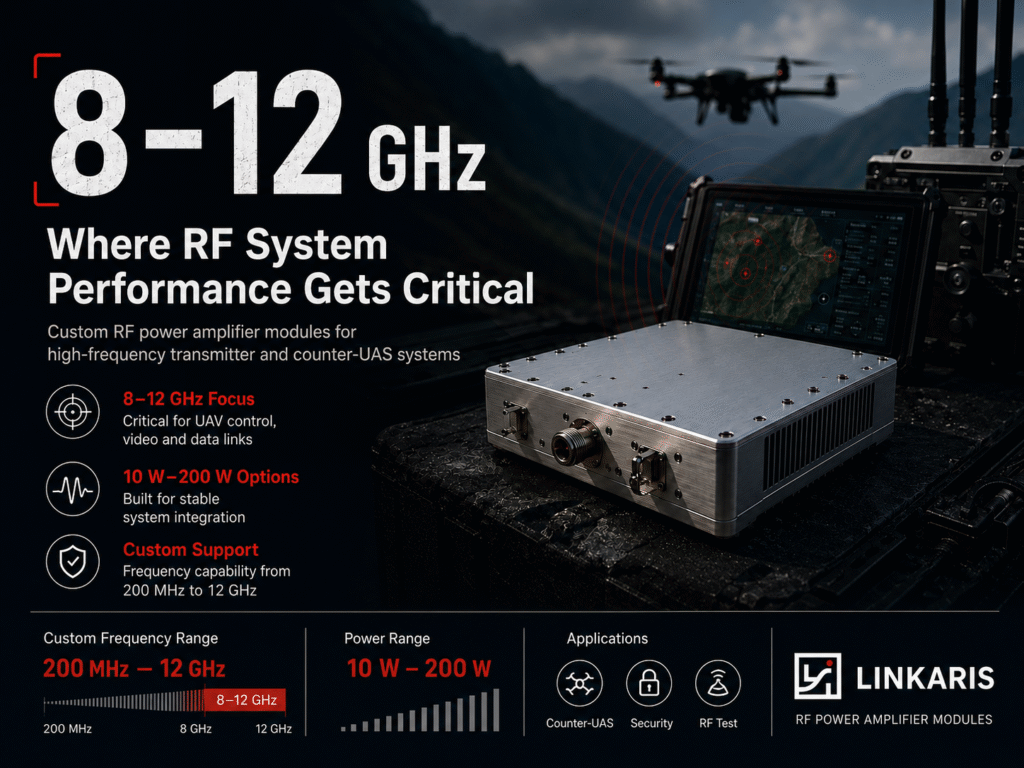
The 8–12 GHz band is widely used in UAV control and high-frequency data links, Counter-UAS systems, tactical RF communication systems, and RF test platforms.
Unlike lower frequency bands, X-band systems operate under stricter constraints:
– Higher sensitivity to thermal drift
– Narrower tolerance for impedance mismatch
– Increased impact of phase and gain instability
– More complex integration with antennas and front-end systems
As a result, RFPA behavior cannot be evaluated in isolation.
2. Why Output Power Alone Is Not Enough
A common misunderstanding in RF system design is assuming that higher output power automatically improves system performance.
System performance depends on:
– Frequency stability across band
– Input drive consistency
– Thermal dissipation under CW or pulsed operation
– Load and antenna matching
– Supply voltage stability
At X-band, these often matter more than wattage ratings.
3. Key RFPA Selection Factors at X-Band
Engineers evaluate four core dimensions:
Efficiency:
How much RF becomes usable output vs heat.
Thermal Stability:
Defines gain stability under continuous operation.
System Fit:
Mismatch between band, drive, and load is a major failure source.
Integration Conditions:
Includes power supply, cooling, mechanical layout, and RF interconnect quality.
4. RFPA Selection Starts From System Conditions
Selection should begin with system constraints:
– Frequency band
– Output power requirement
– Input drive level
– Duty cycle
– Cooling method
– Antenna/load conditions
Only after this can RFPA selection be reliable, especially in X-band systems.
5. Typical Applications in 8–12 GHz
Common applications include:
– UAV communication links
– Counter-UAS systems
– Tactical RF communication
– RF test and measurement
Each application balances efficiency, stability, size, and integration differently.
 Chat with us on Telegram
