From RFPA requirements to stable, controllable and repeatable system performance
An RF power amplifier module may meet its datasheet specifications during bench evaluation and still behave differently after it is installed in the final RF system.
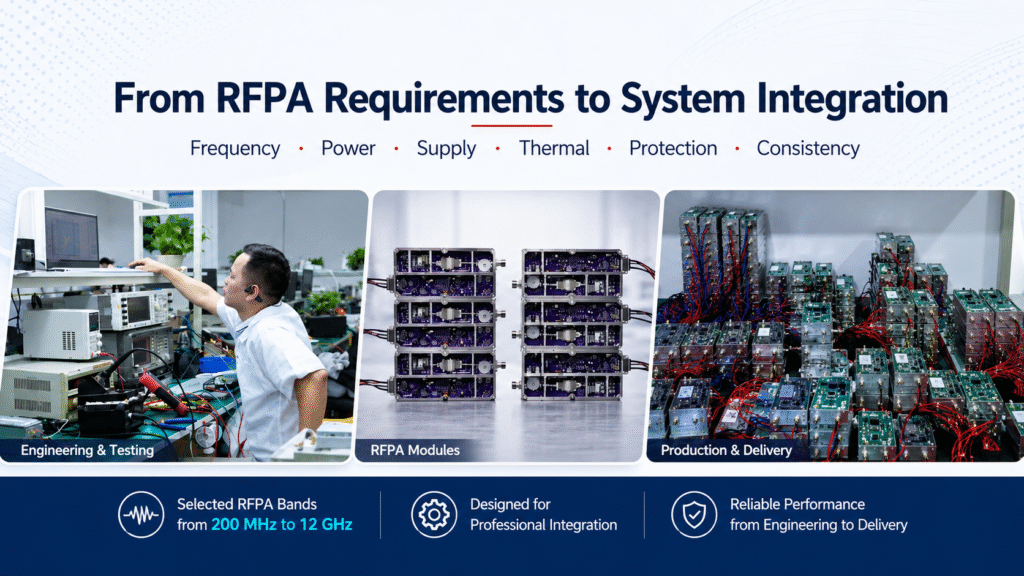
The reason is straightforward: output power is only one part of RFPA performance. A production-ready RF power amplifier must work together with the signal source, power supply, cooling structure, RF load, antenna system and application environment.
For RF system integrators and equipment manufacturers, the real question is not only “How many watts can this amplifier deliver?” The more important question is “Can this RFPA deliver stable and controllable output under the actual system conditions?”
| Watch the Linkaris engineering and production overviewA production-ready RFPA module requires more than a target output-power figure. It must move through requirement evaluation, engineering review, assembly, verification and production control.Open the YouTube videoThe video provides a visual overview of the Linkaris engineering and production process. The sections below explain the system conditions that should be confirmed before an RFPA module is selected for integration. |
1. Output Power Is Only the Starting Point
Output power is often the first parameter discussed in an RFPA project. A customer may request 20 W, 50 W, 100 W or another target level, but the wattage figure alone cannot determine whether the module will perform reliably inside the final equipment.
A higher-power amplifier may create additional thermal, supply and integration pressure. Professional RFPA selection should therefore begin with the operating conditions of the complete RF system, not simply the largest available wattage.
- Frequency range
- Input drive level
- Supply voltage and available current
- Duty cycle
- Cooling conditions
- Antenna or load matching
- Protection requirements
- Module dimensions and installation limits
- Application environment
2. Frequency Matching Comes Before Wattage
An RF power amplifier must be designed and optimized for the required operating band. If the target frequency does not match the amplifier’s designed range, the rated power figure has limited practical value.
It is also essential to distinguish between the supplier’s overall product portfolio and the bandwidth of one individual RFPA module. Linkaris uses the portfolio-level wording “Selected RFPA bands from 200 MHz to 12 GHz”; this must not be interpreted as one module continuously covering the entire range.
Before a module is recommended, the start frequency, stop frequency, operating bandwidth and signal conditions should be confirmed.
3. Input Drive Determines the Achievable Output
An RF power amplifier does not create output power independently. It requires an appropriate RF input signal from the source or driver stage.
If the input drive is insufficient, the amplifier may not reach the requested output level. Excessive input may place the module outside its intended operating condition or increase distortion. Output power and gain therefore need to be evaluated together.
- Input power level
- Signal type and modulation
- CW, pulsed or intermittent operation
- Required gain
- Expected output-power range
4. Power Supply and Thermal Design Define Operating Stability
Higher RF output normally means higher DC power demand and more heat. A module that performs well during a short check may not remain stable during continuous or high-duty-cycle operation if the supply and thermal path are insufficient.
Thermal management is not an accessory added after amplifier selection. It is part of the system design. Without sufficient heat transfer, an RFPA may experience output reduction, current instability, protection activation or long-term reliability problems.
- Available supply voltage and current
- Voltage stability and cable capacity
- Baseplate temperature and heat-sink size
- Air cooling or conduction cooling
- Ambient temperature and installation orientation
- Continuous operating time and duty cycle
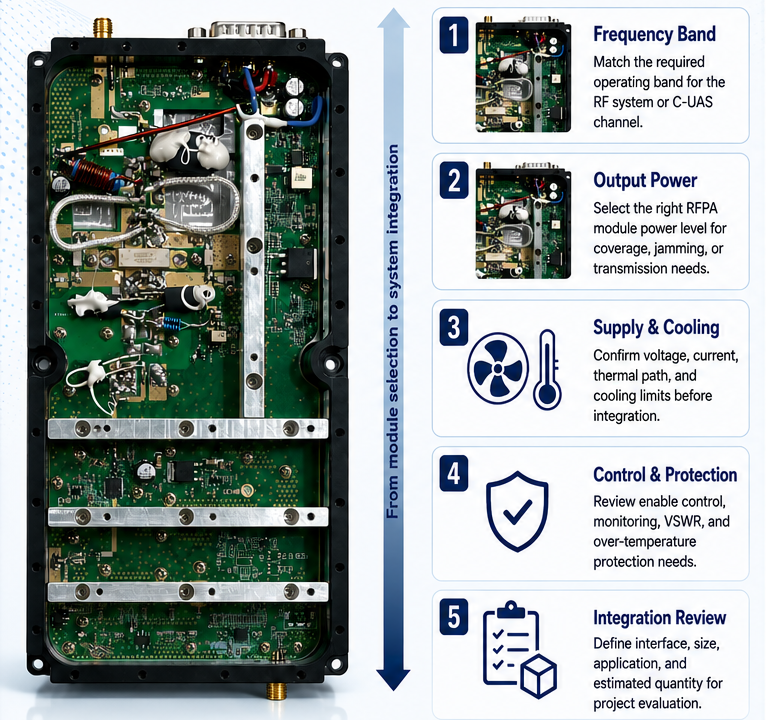
Figure 2. Different RFPA applications require different combinations of band, power, supply, cooling, protection and integration constraints.
5. Control, Protection and Load Conditions Matter
The RFPA output is connected to filters, switches, cables, antennas or other RF loads. If these elements are not properly matched, reflected power may return toward the amplifier and affect output stability, efficiency, temperature or module safety.
System integrators should confirm the expected load condition, enable or control logic, monitoring requirements and the required VSWR or over-temperature protection strategy. The RFPA is a critical power unit, but it cannot independently compensate for every antenna, cable or load problem.
6. One Successful Sample Does Not Guarantee Batch Consistency
A single engineering sample can perform well during laboratory evaluation. The next challenge is whether future units behave consistently.
Variation in power, gain, current consumption, temperature rise, frequency response or matching behavior can increase calibration, incoming inspection and integration work for equipment manufacturers.
Production consistency depends not only on the RF power device, but also on PCB manufacturing, component control, assembly quality, matching and tuning, thermal interface quality, test procedures and final inspection records. The production challenge is not only to make one functional sample; it is to deliver repeatable modules with lower integration uncertainty.
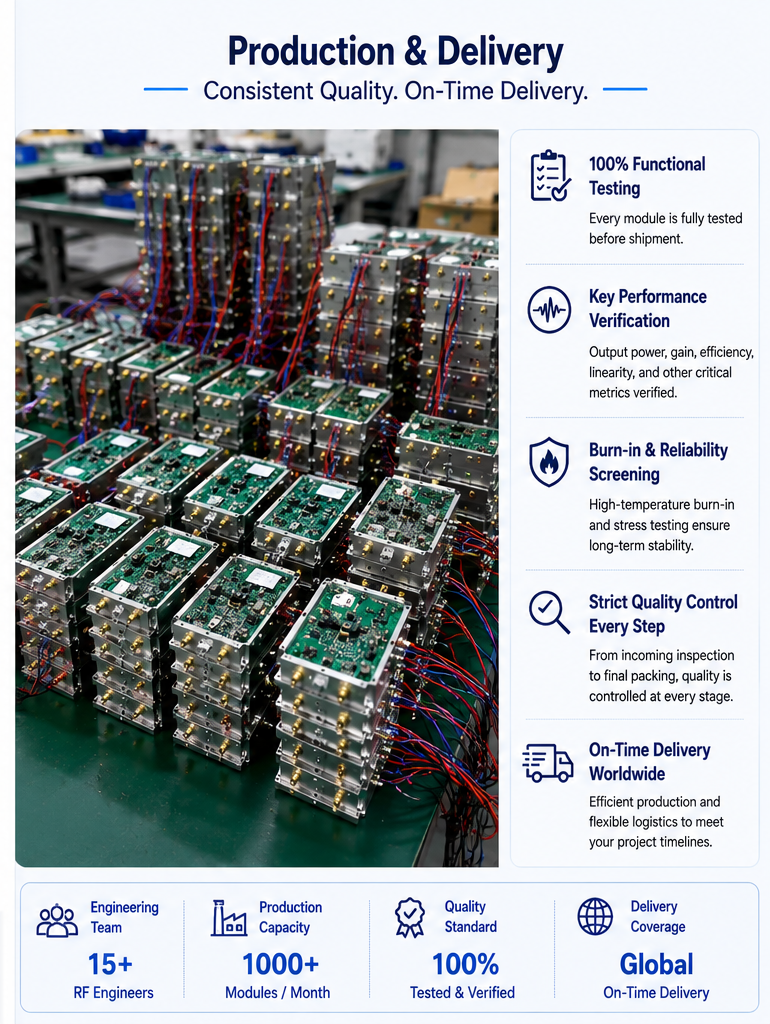
Figure 3. RFPA modules at different production stages. Batch delivery makes assembly, tuning, inspection and verification consistency essential.
7. From Engineering Requirements to Production-Ready Delivery
At Linkaris, RFPA module evaluation begins with the customer’s actual system requirements. The objective is not to recommend a higher-power module without context. It is to determine whether the requested frequency, power, input drive, supply, cooling, interface and operating conditions can form a realistic and deliverable solution.
This approach helps reduce the gap between a datasheet specification and actual system performance.
- Requirement clarification
- Frequency and power evaluation
- Input-drive confirmation
- Supply and thermal assessment
- Module and interface selection
- Protection and operating-condition review
- Production and consistency checks
- Final inspection before delivery
8. What Information Should Customers Provide?
For an initial RFPA evaluation, customers should provide at least the following basic parameters. The more complete the information, the more reliable the technical review can be.
- Required frequency range
- Target output power
- Available input power
- Supply voltage and current
- CW, pulsed or duty-cycle conditions
- Cooling method
- Application scenario and installation platform
- Size and interface limits
- Estimated quantity and current project stage
| Request an Initial RFPA Requirement Review Share your frequency range, required output power, supply voltage and application scenario with the Linkaris engineering team. https://linkaris.tech/ |
9. The Real Value of an RFPA Module
Customers do not only purchase a metal enclosure with a specified wattage. They purchase a power module that must fit into a real system, operate under real conditions and remain consistent during evaluation and delivery.
The strongest RFPA solution is not automatically the module with the highest power figure. It is the module that provides the required RF output under the customer’s actual system conditions with controlled integration risk.
- Appropriate output power
- Frequency compatibility
- Stable amplification
- Supply compatibility
- Thermal control
- Load protection
- Production consistency
- Integration support
Conclusion
A reliable RF power amplifier must be evaluated as part of the complete RF chain. Output power matters, but it cannot be separated from frequency, input drive, supply, thermal design, load matching, protection and production consistency.
For system integrators, the goal is not simply to find an amplifier that reaches a target wattage during a short bench check. The goal is to select an RFPA module that can be integrated, reproduced and delivered with lower uncertainty.
Frequently Asked Questions
Is higher RFPA output power always better?
No. Higher output power increases supply, thermal and integration requirements. The appropriate level should be based on the RF chain, platform and operating conditions.
Why can an RFPA pass bench evaluation but behave differently after integration?
The final system may have different input drive, supply, cooling, antenna, load, duty-cycle or environmental conditions from the initial setup.
What parameters are most important when selecting an RFPA?
Start with frequency range, output power, input power, supply voltage and application. Then review thermal conditions, duty cycle, load matching, dimensions, interface and protection requirements.
Does one RFPA module cover the complete Linkaris portfolio range?
Not necessarily. The product portfolio includes selected RFPA bands from 200 MHz to 12 GHz, while each individual module is designed for a defined operating range.
Why is batch consistency important?
Variation in power, gain, current and temperature can increase calibration, testing and integration work for equipment manufacturers and system integrators.
 Chat with us on Telegram
