A frequency range is not yet a module specification
When a C-UAS project mentions 900-1700 MHz, it is often more than a simple frequency request.
It may indicate that the customer is evaluating a high-power RF output path for a counter-UAS platform, a multi-band RF system, a vehicle-mounted architecture, or a fixed-site protection scenario. In this type of inquiry, the frequency range is only the first visible layer.
The real value of the inquiry is the demand signal behind it.
For Linkaris, 900-1700 MHz can be treated as a serious RFPA discussion point because it falls within Linkaris’ selected RFPA band capability. But it should not be treated as an automatic product promise or a single continuous module configuration.
The correct starting point is: What kind of C-UAS RF output requirement is hidden behind this frequency range?
1. Why 900-1700 MHz should be read as a demand signal
A customer may write: ‘We need a 900-1700 MHz high-power PA.’ At first glance, this looks like a product request. But from a project evaluation perspective, it usually means the customer is still in one of several stages.
| Customer Stage | What the Inquiry May Mean |
| Early system planning | The customer is mapping possible RF bands for a C-UAS platform. |
| RF chain design | The team is checking whether PA modules can support the output path. |
| Supplier comparison | The buyer is testing which supplier can understand technical constraints. |
| Prototype preparation | The project needs a module direction before detailed validation. |
| Replacement / upgrade | Existing PA output, cooling, or load behavior may not be sufficient. |
This is why Linkaris should not respond with only a product list. A better response is to help the customer convert a broad demand into a defined RFPA evaluation path.
2. The risk of treating 900-1700 MHz as one simple band
The phrase 900-1700 MHz can hide several different engineering cases.
One customer may need a narrower operating section inside the range. Another may need multiple sub-bands. Another may need high-power output only in one defined area. Another may care more about duty cycle, cooling, and platform size than headline power.
These are not the same project.
A wide frequency expression does not automatically mean one PA module should cover every point from 900 MHz to 1700 MHz continuously. Each RFPA module must be evaluated according to a defined operating band and application condition.
This distinction matters because it prevents three common mistakes:
- Assuming the full range is required continuously
- Assuming higher power alone solves the project
- Quoting before the real operating condition is known
For C-UAS projects, these mistakes can lead to wrong module selection, late-stage redesign, or unrealistic delivery expectations.
3. What this demand tells us about the customer
A 900-1700 MHz C-UAS PA inquiry is usually not a low-value ‘price only’ inquiry.
It often suggests that the customer already understands at least part of the RF output chain. They may be thinking about:
- RF output coverage
- System-level power class
- Antenna or load behavior
- Duty cycle during operation
- Thermal pressure inside the platform
- Supply voltage and current capacity
- Field deployment format
- Supplier capability for customized RFPA support
That makes this type of inquiry valuable for BD and technical screening. The question is not only whether the customer wants a PA module. The question is whether the customer has a real C-UAS system project behind the request.
4. Demand class: why high-power discussion must stay cautious
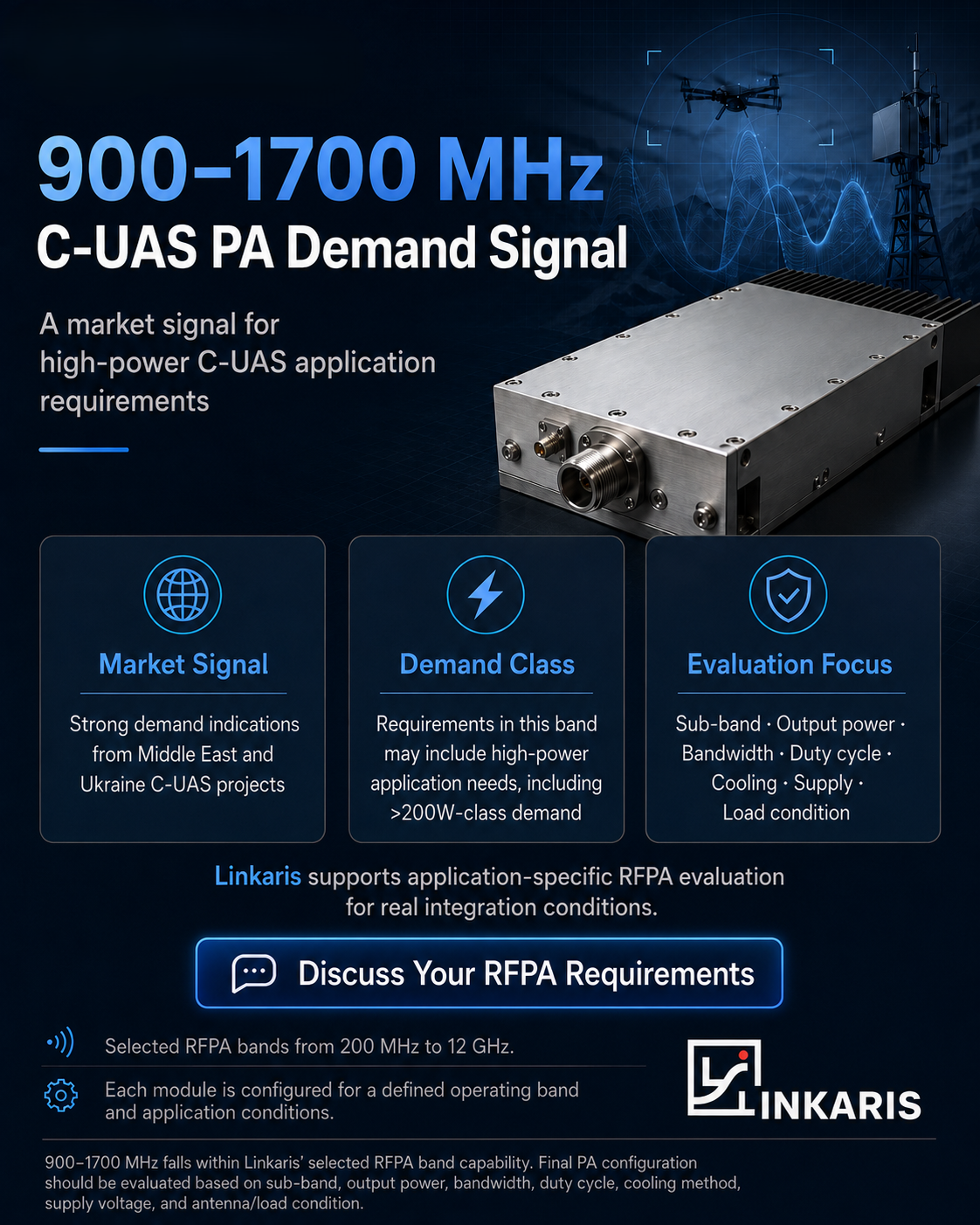
The image highlights a possible >200W-class demand. This is useful as a market signal, but it should be expressed carefully.
A safer and more professional way to understand it is: Requirements in this band may include high-power application needs, including >200W-class demand signals, but the final PA configuration depends on the actual sub-band, bandwidth, duty cycle, cooling, supply voltage, and load condition.
This wording is important because high-power RFPA feasibility is not decided by wattage alone.
A >200W-class discussion can create very different technical requirements depending on whether the system is narrowband or broadband, continuous or intermittent, forced-air cooled or conduction cooled, vehicle-mounted or fixed-site, matched load or changing antenna condition.
For Linkaris, the right message is not: ‘We can provide any 900-1700 MHz >200W PA.’ The right message is: ‘900-1700 MHz is within the selected RFPA band capability. The final PA configuration should be evaluated based on the real operating conditions.’
That makes the content credible and reduces over-commitment risk.
5. Evaluation focus: turning a broad inquiry into an RFPA review
When a customer sends a 900-1700 MHz C-UAS PA requirement, Linkaris should guide the conversation with a structured review.
| What the Customer Gives | What Linkaris Should Clarify | Why It Matters |
| 900-1700 MHz | Exact sub-band or required operating sections | Determines whether the module direction is narrowband, multi-band, or customized. |
| High power | Required output power at the PA output | Separates target power from system-level RF loss. |
| C-UAS application | Platform type and operating mode | Fixed-site, vehicle-mounted, portable, and integrated systems create different constraints. |
| PA module request | Input drive level and gain requirement | Confirms whether the RF chain can drive the PA correctly. |
| Long operation | Duty cycle and thermal condition | Determines cooling pressure and reliability risk. |
| System integration | Supply voltage, current, connector, size, and cooling method | Determines whether the module can physically and electrically fit the system. |
| Antenna/load | VSWR or reflected-power protection expectation | Helps reduce risk under non-ideal load conditions. |
| Project need | Quantity and project stage | Separates real project evaluation from general price inquiry. |
This transforms the conversation from a generic product inquiry into a real RFPA project review.
6. How Linkaris should position this capability
For this topic, Linkaris should not position itself as only a seller of high-power PA modules.
The stronger positioning is: Linkaris supports application-specific RFPA evaluation for real C-UAS integration conditions.
This matches the message shown in the image and makes the Blog more practical for both customers and BD teams.
For customers, it means Linkaris can help them clarify whether their 900-1700 MHz requirement is technically realistic. For BD teams, it gives a clear way to judge inquiry quality. For RF engineers, it shows that Linkaris understands the difference between a frequency request and a deployable PA configuration.
7. What customers should send before asking for a quote
Before quoting or recommending a module direction, the following information is recommended:
- Required frequency band or sub-band:
- Target output power:
- Input power level:
- Bandwidth requirement:
- Supply voltage and current:
- Duty cycle / working mode:
- Cooling method:
- Antenna or load condition:
- Platform type:
- Size or mechanical limits:
- Estimated quantity:
- Project stage:
A customer who can provide these details is much more likely to have a real RFPA project. A customer who only asks for price without frequency, power, cooling, or application conditions may need further qualification before entering technical review.
8. Why this matters for C-UAS project development
C-UAS systems often move from concept to field requirement quickly.
In this process, RFPA selection can become a bottleneck if the project team only defines a frequency range and power target but does not clarify the operating conditions.
A PA module may look suitable on paper, but later face issues such as thermal overload, insufficient input drive, unstable supply current, mismatch with antenna or load, unrealistic continuous operation requirement, mechanical space conflict, or late change from sample evaluation to batch delivery.
This is why a 900-1700 MHz inquiry should be handled as an engineering discussion, not just a sales request.
The earlier the requirement is clarified, the easier it is to reduce integration uncertainty.
Conclusion: a strong signal, not a simple specification
The 900-1700 MHz C-UAS PA demand signal is valuable because it shows where customers may be moving: toward higher-power, application-specific RF output requirements in real counter-UAS systems.
But the frequency range itself is not enough to define the final RFPA module.
For Linkaris, the correct approach is to evaluate the requirement through sub-band, output power, bandwidth, duty cycle, cooling method, supply voltage, input drive, antenna/load condition, platform constraints, and project stage.
A strong RFPA solution is not only about reaching a power number. It is about turning a broad C-UAS demand signal into a realistic, testable, and integrable RFPA module direction.
CTA: Discuss your RFPA requirements with Linkaris. Share your sub-band, output power, bandwidth, duty cycle, cooling method, supply voltage, and load condition, and our team can help review a suitable RFPA direction for your project.
 Chat with us on Telegram
