In many RF projects, the first selection question is simple:
“How much output power do we need?”
10W, 30W, 50W, 100W, or higher.
Output power is important. But in real RF system integration, power is only one side of the decision.
A PA module does not work in isolation. Once it enters a real system, higher output power usually brings higher thermal load, higher current demand, stricter cooling requirements, and greater stability pressure.
That is why RFPA selection should not be treated as a single power-number decision.
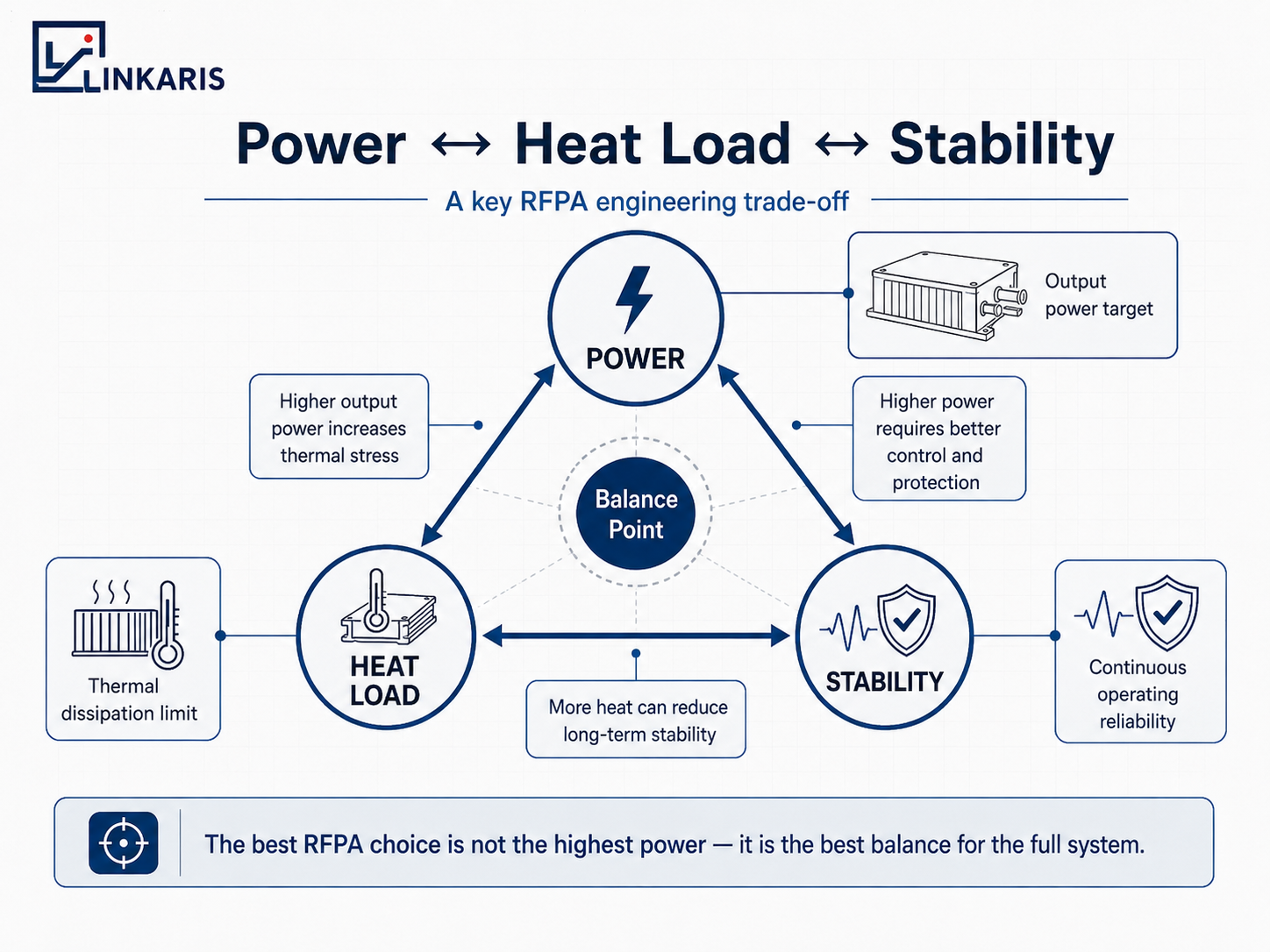
It is a balance between three factors: output power, thermal load, and long-term stability.
1. Higher Power Creates Higher Thermal Pressure
When an RFPA module delivers more output power, the system must also handle more electrical and thermal stress.
Not all input energy becomes useful RF output. Part of the energy is converted into heat.
If this heat cannot be removed effectively, the amplifier may face:
- rising case temperature
- reduced efficiency
- output drift
- unstable gain
- protection shutdown
- shorter component lifetime
- higher risk during continuous operation
This is why a high-power RFPA module cannot be evaluated only by its rated output.
Engineering question: Can the final system remove the heat generated during real operation?
2. Thermal Design Affects RF Stability
Thermal pressure does not only affect mechanical design. It can also affect RF behavior.
When temperature rises, the amplifier may not behave exactly the same as it did during short bench testing.
Possible issues include:
- gain variation
- output power fluctuation
- frequency response changes
- higher current draw
- reduced operating margin
- unstable performance under continuous duty cycle
This is especially important for integrated RF equipment, UAV communication links, C-UAS systems, RF jamming platforms, and field-deployed communication devices.
A module that looks acceptable during a short test may still create problems after long operation inside a compact system.
The key question is not only: Can the module reach the target power? The more important question is: Can it maintain stable output under the customer’s real thermal condition?
3. Stability Is Not Just a Datasheet Word
In RFPA selection, stability should not be understood as a vague marketing claim.
For engineers, stability is connected to several real conditions:
- frequency band
- output power
- input drive level
- supply voltage and current
- load matching
- antenna condition
- VSWR protection
- cooling method
- duty cycle
- installation structure
- operating temperature
- continuous working time
If these conditions are not clear, it is difficult to judge whether a PA module is truly suitable for the project.
That is why a module should be evaluated inside the full RF chain, not only as an isolated component.
4. The Triangle Constraint: Power, Heat Load and Stability
In many projects, these three factors pull against each other.
Higher output power may improve RF output capability, but it also increases thermal load.
A smaller module may be easier to integrate, but it gives less room for heat dissipation.
A lower-cost design may look attractive at the buying stage, but it may leave less margin for protection, testing, and long-term reliability.
For RFPA projects, the best choice is rarely the highest-power module on paper. The better choice is the module that matches the full operating condition.
This includes:
- required frequency band
- target output power
- available input power
- supply voltage and current
- cooling method
- module size limit
- antenna or load condition
- duty cycle
- operating environment
- final application scenario
Only after these details are clear can engineers judge whether a standard module, semi-custom module, or customized RFPA solution is more suitable.
5. Why Bench Testing Is Not Enough
A short bench test can confirm basic output performance. But it may not fully represent field operation.
In real systems, the PA module may face:
- limited airflow
- compact enclosure design
- unstable power supply
- antenna mismatch
- long working time
- vibration or movement
- high ambient temperature
- repeated on/off operation
- multi-module integration
These conditions can change how the amplifier behaves after integration.
That is why engineers should evaluate not only peak output power, but also the module’s thermal path, protection logic, working mode, and long-term stability under the final system environment.
6. What Should You Confirm Before Selecting an RFPA Module?
Before choosing an RFPA module, it is better to prepare the following information:
- Required frequency band
- Target output power
- Input power level
- Supply voltage and current
- Working mode: continuous, pulsed, or intermittent
- Duty cycle
- Cooling method
- Available space and module size limit
- Connector type
- Antenna or load condition
- VSWR protection requirement
- Final application scenario
- Expected working time
- Estimated quantity and project stage
These details help avoid choosing a module that meets the power target but fails after integration.
Linkaris RFPA Support
At Linkaris, RFPA selection is not treated as a simple wattage comparison.
We help customers evaluate frequency, power level, voltage, thermal condition, size, load condition, protection requirements, and system integration needs before recommending a suitable PA module.
For real RF projects, the goal is not only to reach higher output power.
The goal is to achieve controllable RF output under the customer’s actual operating condition.
Need Help Evaluating Your RFPA Requirement?
If you are selecting an RFPA module for an integrated RF system, send us your key parameters. Our engineers can help check whether your required output power, thermal condition, supply voltage, cooling method, and application scenario are aligned before you move further in system integration.
 Chat with us on Telegram
